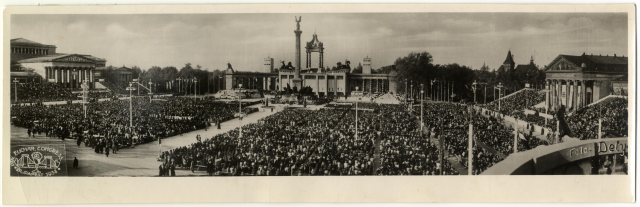
The Eucharistic Congress in the Catholic Church is a feast that derives from the Lord's Day processions. On this event, the faithful celebrate Christ present in the Eucharist with the clergy. The Catholic Church teaches that at the Last Supper, Jesus bequeathed to his disciples and their successors, the priests, the mystery of the transformation of the bread and wine into his body and blood, thus bequeathing himself to humanity.
The World Eucharistic Congresses have their roots in the 19th century, with the first being held in 1881 in Lille, France, and then repeated annually every two years, mainly in Western Europe. The first overseas World Congress had to wait until 1910, when it was held in Montreal, Canada. In our region, Vienna was the only place where the event was organised in 1912, and after that it was only at the time of the Budapest World Congress that the Central European states had the opportunity to host the Catholic faithful of the world again. The choice of the year was not a coincidence, as it was the 900th anniversary of the death of the holy king who founded the state of Hungary. Although the congress was not an integral part of the commemoration of the Year of St. Stephen, it was nevertheless intertwined with the celebration of the state.
The virtual exhibition aims to present the outstanding persons, places and events of the 34th World Eucharistic Congress, which took place from 25 to 29 May 1938, in a non-exhaustive way, with photographs preserved in the Historical Photographic Collection of the Hungarian National Museum. The exhibition is curated by Lajos Sóti.