Room 6 / Ottoman period
After the Battle of Mohács the Kingdom of Hungary was split into three parts. The room displays artefacts from the Ottoman occupation including many treasure troves. We will recall the frontier fortresses and battles, present the characteristics of Turkish weaponry and Ottoman art. The room also houses the choir stalls commissioned by the Báthory family for the church in Nyírbátor, decorated with inlays.
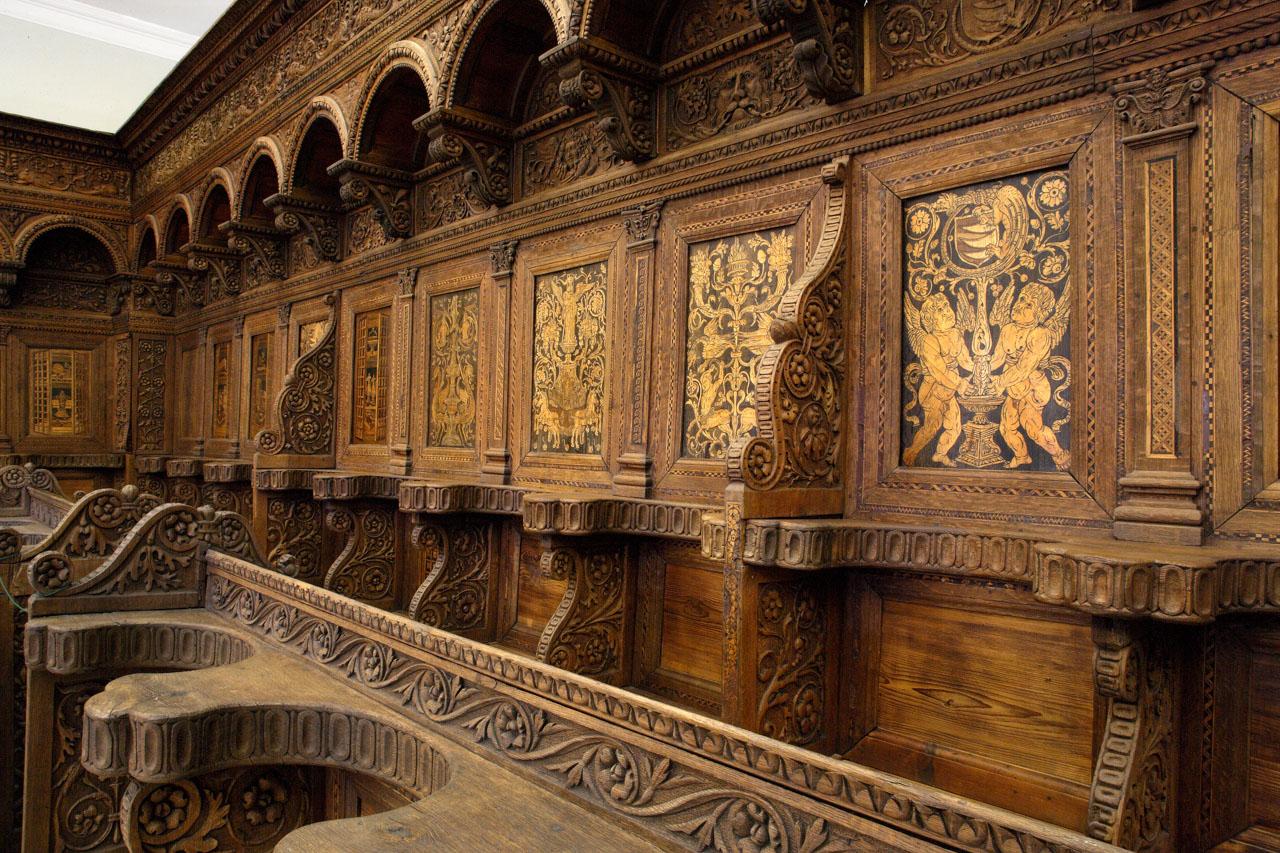
The rapid spread of the Renaissance style in Hungary was mainly brought about the splendour of King Matthias's and Queen Beatrix's royal court. An outstanding example of this is the choir stalls commissioned by the Báthori family. The cornices, friezes, dividing and supporting balustrades, back walls, elbow and seat frames, side walls, partitions and linings under the seats were carved and inlaid with Renaissance-style decoration. A full panel shows the names and ranks of the patrons and the year of manufacture (György, István and András Báthori, 1511), while another backrest bears the maker's mark F. Marone. Some of the inlaid backrests depict cabinets with half-open doors and shelves with books and kitchen utensils.
The estates of Lower Austria once paid homage to Miklós Pálffy, one of the commanders of the Christian troops who recaptured Győr from the Turks, with this gold goblet of considerable weight. This important victory is commemorated by the inscription on the shield of the Roman warrior trampling on the Turkish shield: GOT DIE ER 1598 (God's is the glory). The trophy had an adventurous journey in the 17th century, and from 1653 it became the inalienable heritage of the family by the will of Palatine Pál Pálffy. It came into the collection of the National Museum as a donation from the family in the 20th century.

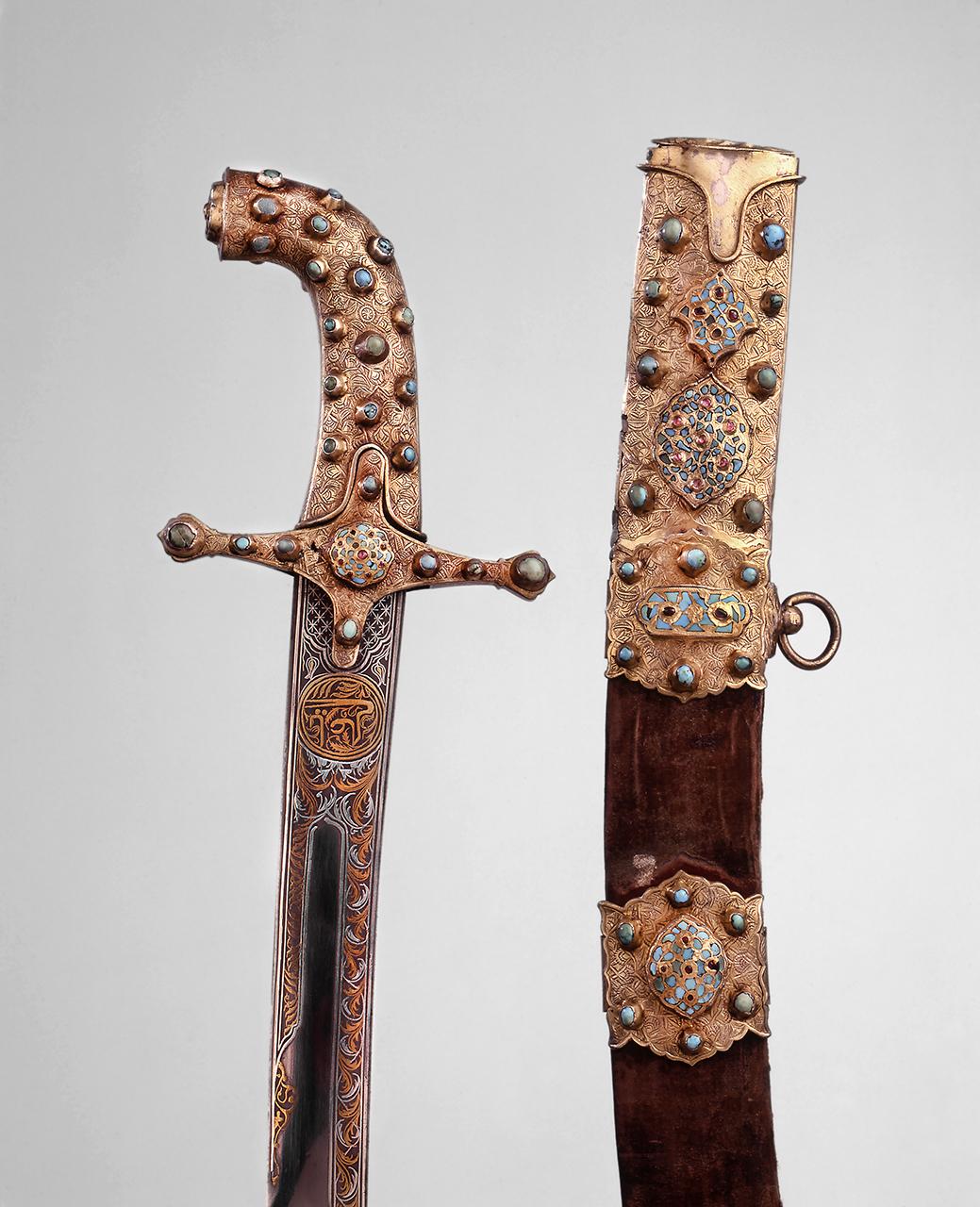
The saber, richly decorated with gilded silver, gold, rubies and turquoise, crafted in the Ottoman Empire, was donated to the collection by Ferenc Révay. Its false-edged curved blade has a wide groove in the centre surrounded by gold-damascened sedge leaves and silver-plated lattice motifs. One of the surfaces of the blade bears the inscription O Ali! inlaid in gold. The centre of the scabbard is covered with velvet.
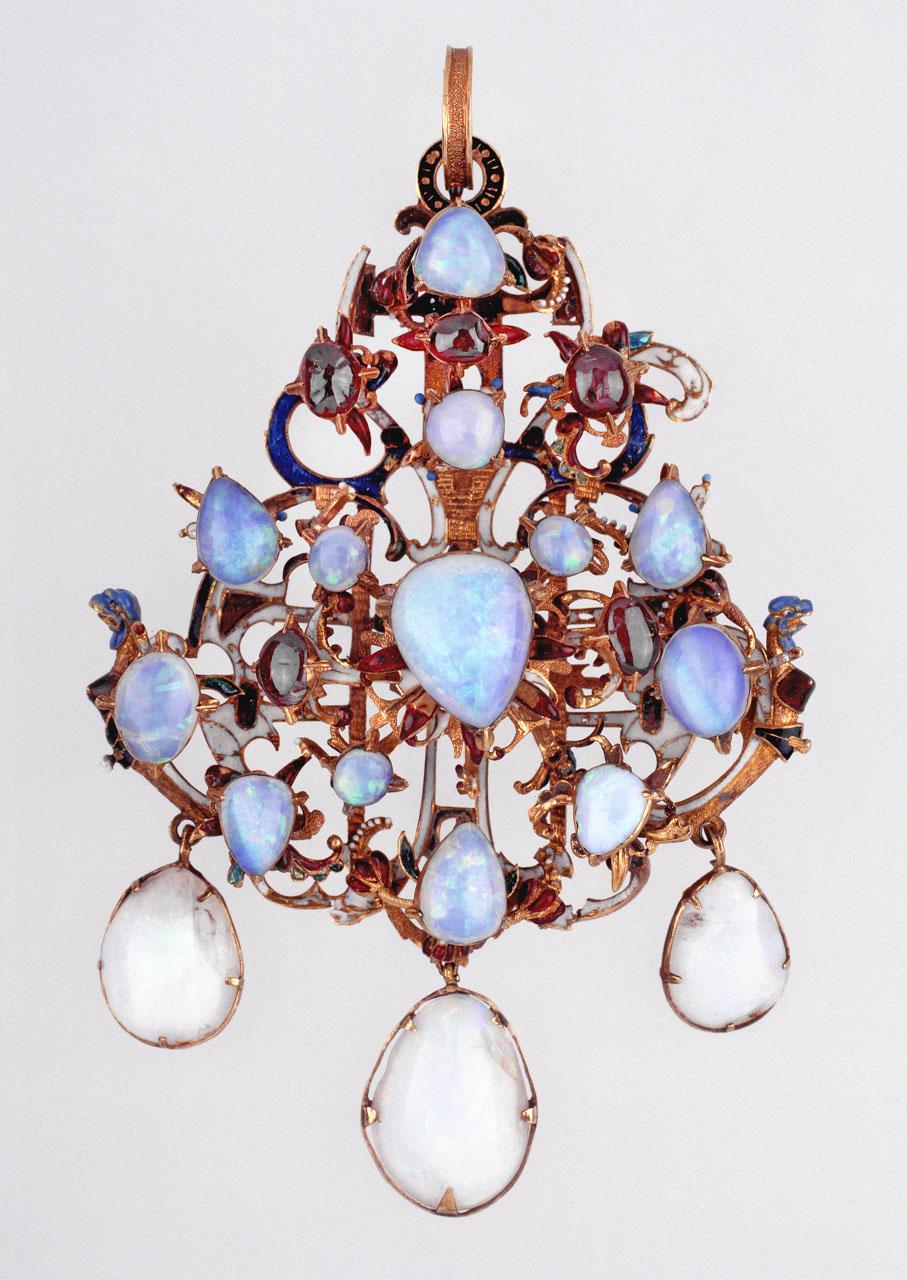
Although precious opal was a popular gemstone in early modern jewellery, very few surviving examples are known. This unique piece came to the National Museum with the collection of Miklós Jankovich. Legend has it that the pendant was once Isabella Jagiellon, wife of János Szapolyai's jewel. However, this is not supported by sources and the style of the object contradicts it. However, the beautiful jewel was probably made in Transylvania or Poland in the early 17th century.