Room 5 / Iron Age
The technology of ironworking became widespread at the dawn of the period from the 8th century BC to the Roman conquest (early 1st century AD). In the first half of this period, the Transdanubian region was home to communities of the Hallstatt culture, which was based on the traditions of the Late Bronze Age. Their power and wealth are attested to by their monumental burial mounds. In the eastern Carpathian Basin, new groups emerged to teach the local inhabitants oriental, steppe technologies and ways of life. In the 4th century BC, the entire territory of Hungary was conquered by the Celts from the West, and it was from here that their warriors set out on their campaigns against the Greek world.
Fun facts:
- Százhalombatta takes its name from the graves of the vast Early Iron Age cemetery near the town.
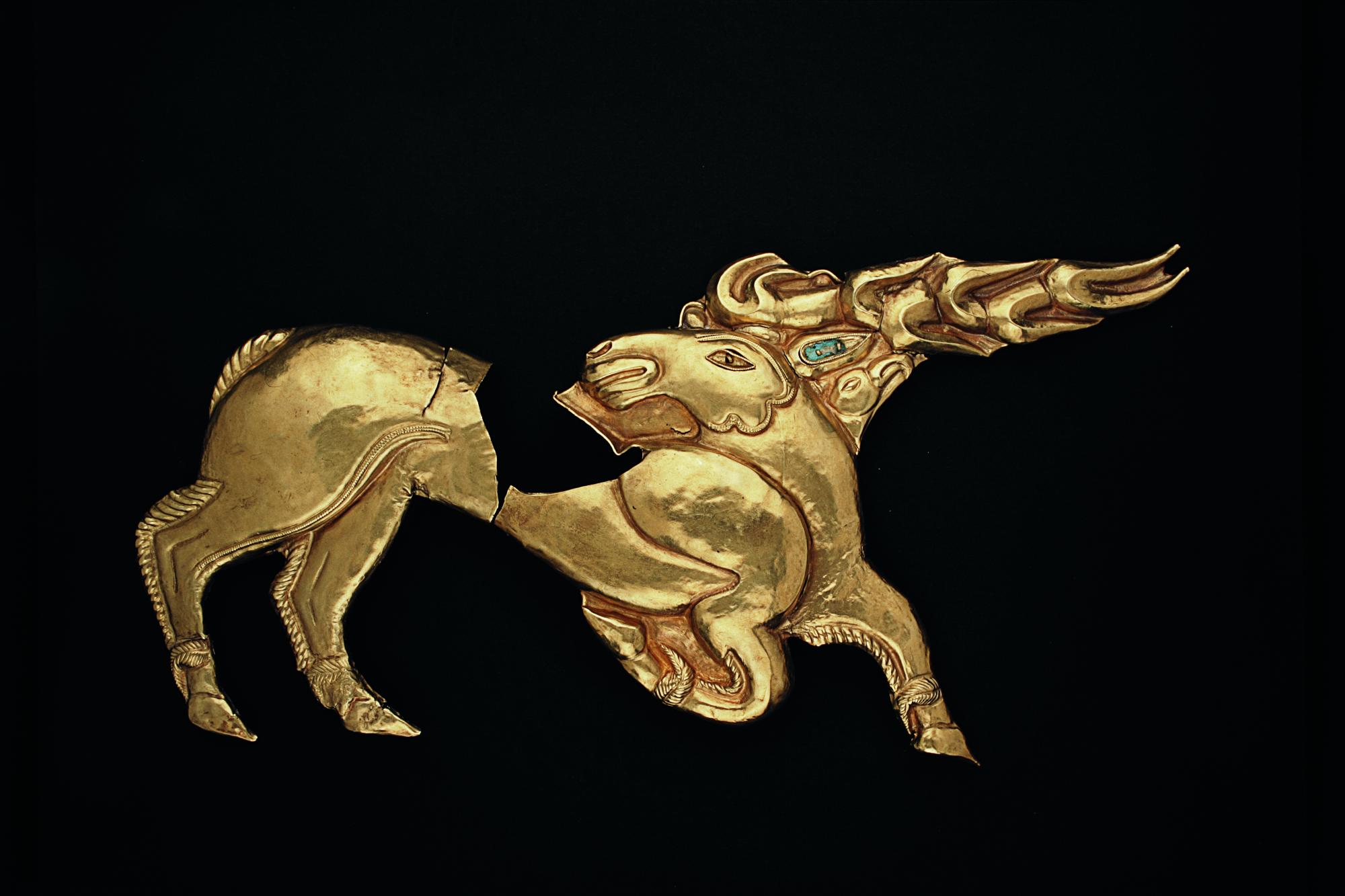
- If you look closely at the stag of Zöldhalompuszta, you may discover another animal hidden at its neck.
The golden stag, dating to the end of the 7th century BC or the 6th century BC, is one of the most spectacular objects of the Iron Age of the Carpathian Basin, and a representative of the so-called Scythian animal style. Once about 37 cm long, it was made from a hammered gold plate, which was embossed and worked into a relief. The object was found in a burial mound in 1928, along with a gold chain with lion figures, ornamental buttons and a pendant. Similar golden stags have been found in monumental Scythian burial mounds on the northern shores of the Black Sea, and it is possible that the Hungarian example was made by a master craftsman living east of the Carpathians. Observations made during the excavation of the tombs here and the small rings on the back of the plate, which allowed it to be sewn on, suggest that the golden stag may have served as a quiver ornament for its noble owner, buried in the 6th century BC.
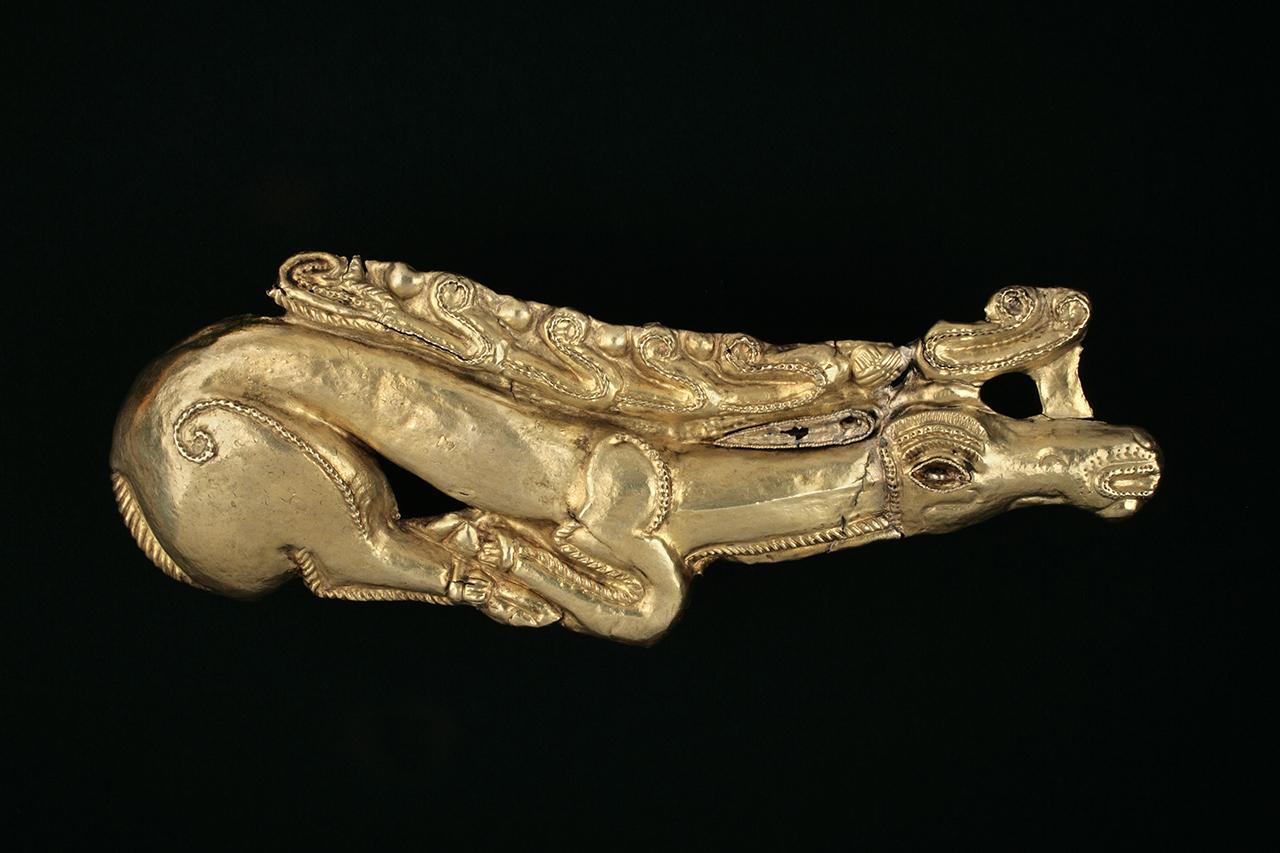
The stag figure of Tápiószentmárton, made of electrum (an alloy of gold and silver), may also have belonged to one of the most powerful people of the 6th century BC. The object, probably originally used as a quiver ornament, was cylindrically folded when it was found. Similar to the Zöldhalompuszta stag, it was made in the Scythian animal style, and it may have been crafted by a master silversmith active on the Northern shores of the Black Sea.
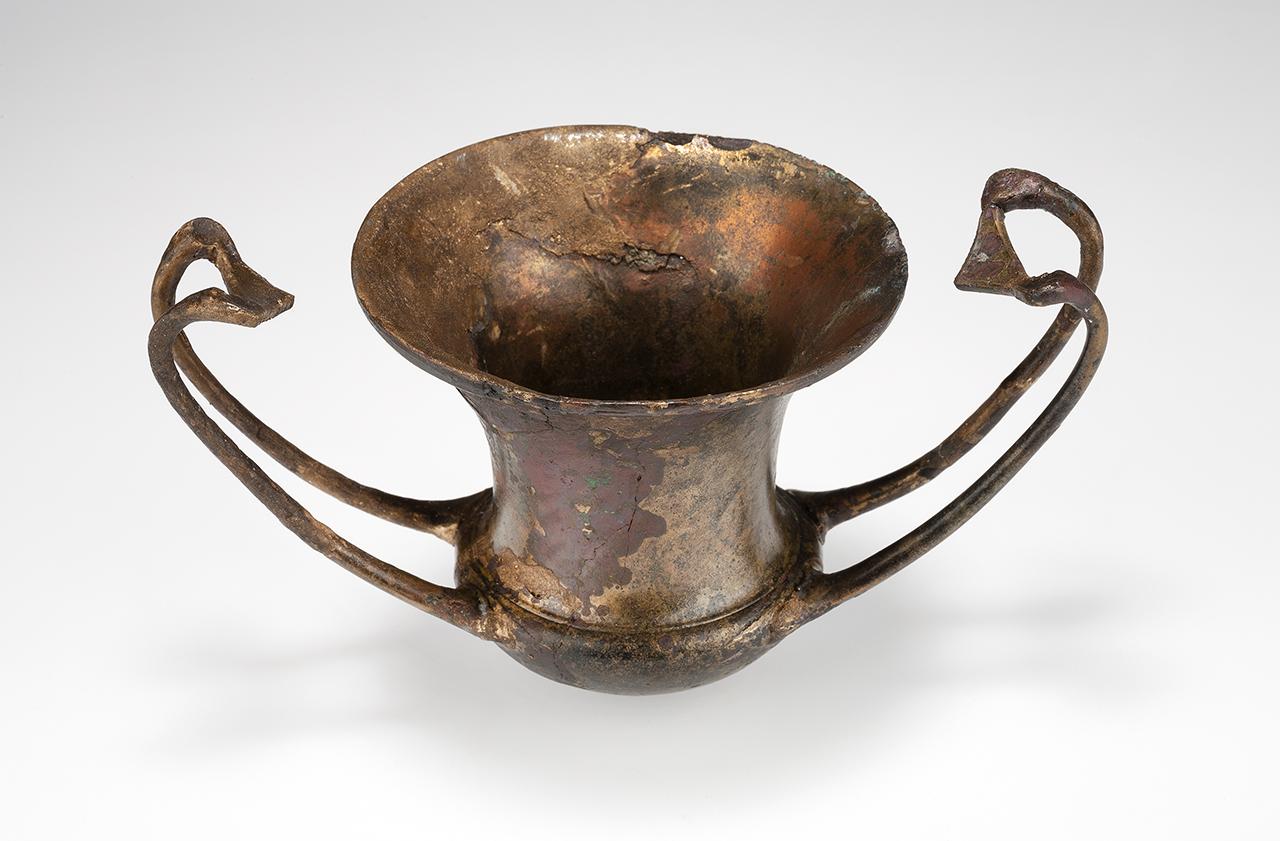
The small bronze vessel was found in a Celtic tomb on the outskirts of Szob in 1935. The Danube Bend region is of major importance in Carpathian Basin Celtic archaeology, with several large Late Iron Age cemeteries with abundant finds having been excavated in the area. The importance of the kantharos discovered in Szob lies mainly in its origin. It was probably made in a Greek workshop in the late 4th century BC or early 3rd century BC. Whether it was brought to the Carpathian Basin by trade or as booty during the Celtic campaigns cannot be determined with certainty.