
The member institutions of the Hungarian National Museum are marking the 700th anniversary of the birth of King Louis I (the Great) of Hungary with a varied programme full of exciting events. The commemorative year began on 5 March 2026, the king’s birthday, with the opening of a cabinet exhibition in the Hungarian National Museum in Budapest. Visegrád, the ruler’s former residence, will serve as a venue for further events during the year.
The Golden Age of the medieval Kingdom of Hungary
The reign of Louis I (1342–1382) was one of the most remarkable periods in Hungarian history. During his four decades on the throne, the ruler of the Angevin dynasty—who was also related to the Árpád dynasty—made Hungary one of the richest and most powerful kingdoms in Europe.
The country’s economy was strong during the reign of Louis I, largely thanks to the abundance of precious metal deposits, and especially the yield of the gold mines. This stable background enabled him to maintain internal peace, pursue a successful foreign policy, and foster cultural and artistic development.
Through his conquests and the acquisition of the Polish crown, Hungary became the centre of a vast European realm. His reign witnessed significant urban development, the flourishing of trade and crafts, and a strengthening of the legal framework behind the social order. The first Hungarian university was also founded in Pécs during his rule.
Louis I as an ideal ruler
In the Middle Ages, Louis I was regarded as the model of a just and virtuous king. According to Antonio Bonfini, historiographer of King Matthias, Louis sometimes travelled through the country in disguise, protecting the poor from the abuses of the powerful. Bonfini even claimed that, “while in disguise, the king would ask people about the ruler’s conduct and occasionally corrected his own behaviour based on their answers”.
The king’s treasures – A selection of surviving objects
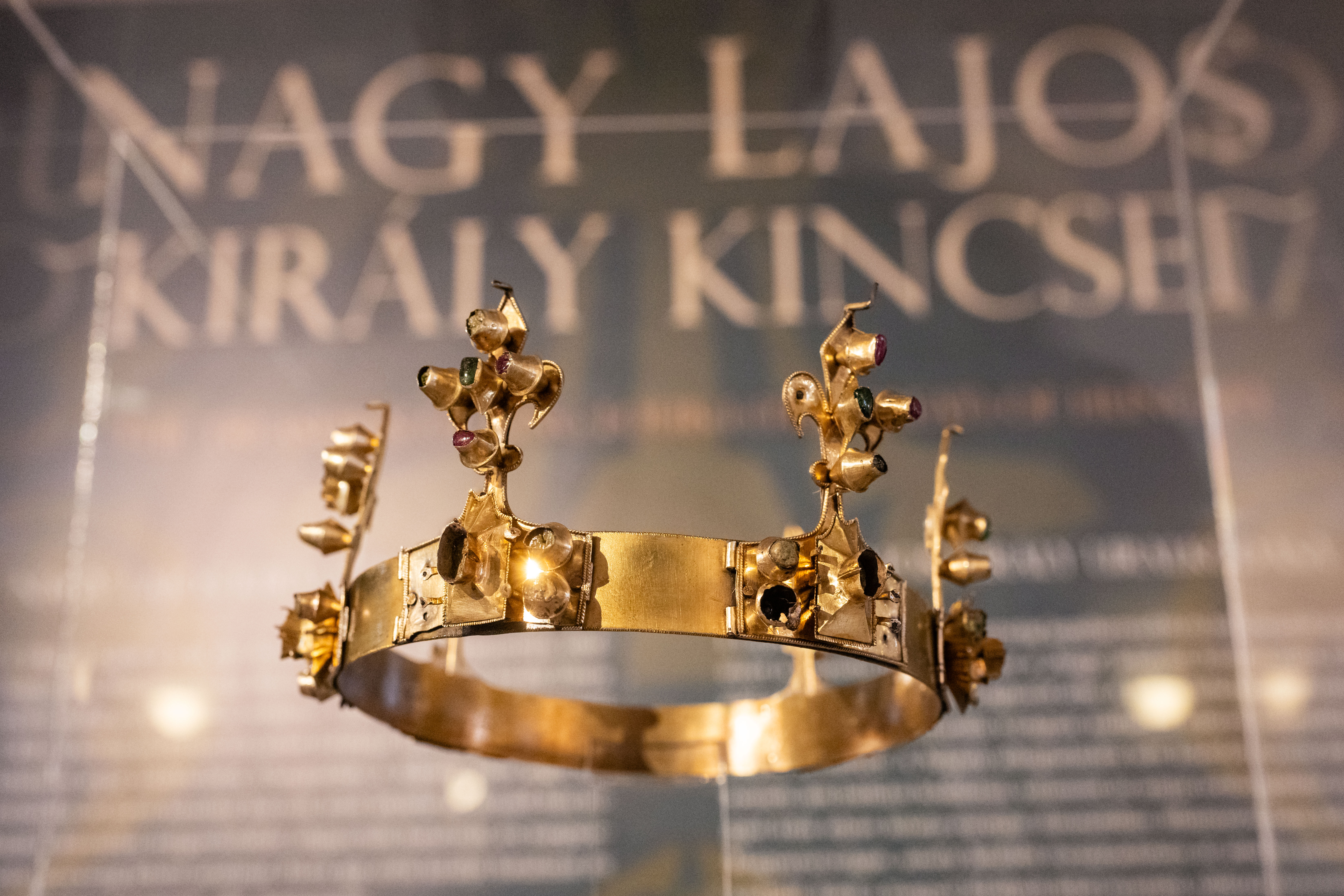
Only a few outstanding goldsmiths’ works and some of the once widely sought-after gold florins issued by the king have survived in Hungary from the legendary wealth of Louis I. However, numerous objects have been uncovered in Visegrád, his former seat, which testify to the splendour of his court.
This cabinet exhibition presents a representative selection of these remarkable finds, illustrating the advanced economy and art of the Kingdom of Hungary in the fourteenth century. Although the castles and palaces once renowned across Europe now lie in ruins, modern digital technology allows them to be virtually reconstructed. A film shown in the exhibition demonstrates this digital revival.
The temporary cabinet exhibition The Treasures of King Louis I (the Great) of Hungary can be seen in the Medieval Lapidary of the Hungarian National Museum until 31 December 2026. The exhibition can be visited with any exhibition ticket valid for that day.
Visit us and discover the material heritage of one of the most intriguing periods in the history of the medieval Kingdom of Hungary.
The first gold florin of King Louis I, struck after the Florentine model, from the Coin Collection of the Hungarian National Museum
The model of the coin and the video were created by Pazirik Informatikai Kft., based on a photograph from the Hungarian National Museum.
The creators of the animated film Residences of Louis the Great, produced for the anniversary, are Gergely Buzás, curator of the exhibition, and András Balogh, managing director of Pazirik Informatikai Kft. You can see an excerpt from this film.