We would like to inform our esteemed visitors that from 2 December 2025, the exhibition spaces of The Coronation Mantle, The Seuso treasure – The Splendour of Roman Pannonia, the Széchényi Hall, and the Open Repository will be temporarily closed due to renovation works.
Thank you for your understanding. We wish you a pleasant visit to our open exhibitions!
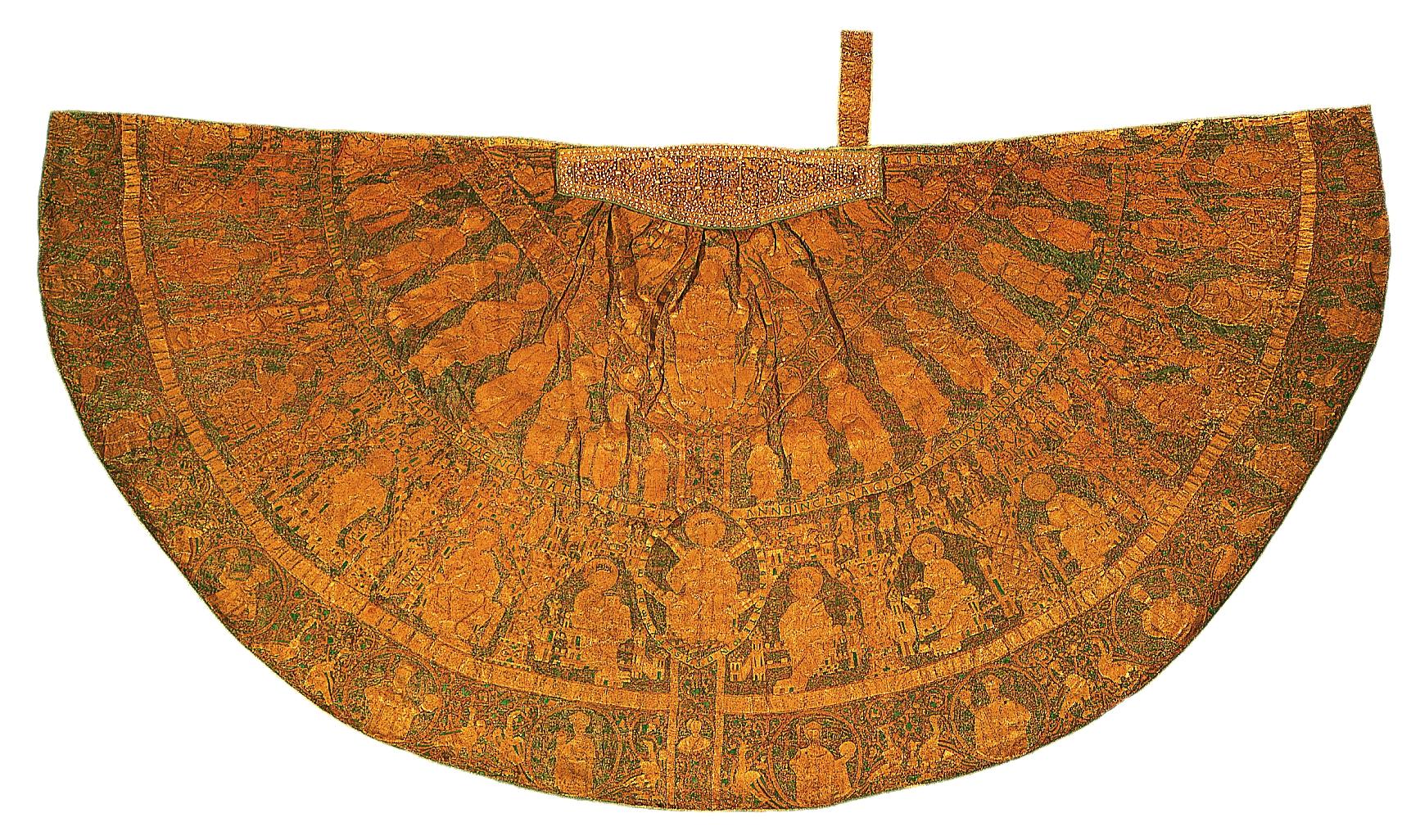
The mantle was originally a bell-shaped, closed chasuble, which was later converted into a mantle. According to the inscription embroidered on it, it was commissioned by King St Stephen (997–1038) and Queen Gisella and presented to the Church of the Virgin Mary in Székesfehérvár in 1031: ANNo INcARNACIONIS XPI : MXXXI : INDICCIONE : XIIII A STEPHANO REGE ET GISLA REGINA CASULA HEC OPERATA ET DATA ECCLESIAE SANCTA MARIAE SITAE IN CIVITATE ALBA.
Its fabric is Byzantine silk in rosette pattern, almost entirely covered with embroidered decoration in gold thread. On the back is a Y-shaped cross. On the forked ends of the coronation mantle there are busts of angels, and on the vertical stem, Christ is depicted twice below one another. In the upper image, he appears as the conqueror of death, trampling two beasts underfoot; in the lower, as the judge of the world, he sits on his throne. The rest of the decoration is arranged in bands, with the prophets of the Old Testament above, and below them, separated by the dedicatory inscription, the apostles sitting in richly segmented turreted niches. At the bottom, in a round medallion separated by a pair of birds, are the first martyrs of Christianity. Between them, at the foot of the cross, is a portrait of the donor royal couple, accompanied by an inscription.
Saint Stephen is depicted with a crown of precious stones, a winged spear in his right hand and the orb in his left. Queen Gisella appears with a similar crown and a tower-shaped reliquary in her hand. Between them, on the arm of the cross, in a smaller circular frame, is a bust of a young man, probably Prince Emeric.
A wide band on the bust of the chasuble was cut out during the alteration, and only small details have remained of the former square and mandorla-framed scenes (mandorla is the almond-shaped halo surrounding Jesus's, Mary's and saints' figures).
.
The ample inscriptions on the mantle contain both the names of the figures and the Latin hexameter interpretative texts embroidered on the frames. The mantle depicts the figures of Te Deum, one of the most famous hymns of the Middle Ages, with a succession of angels, prophets, apostles and saints, too.
The transformation may have taken place around the turn of the 12th and 13th centuries, when sleeveless mantles falling long from the shoulders came into fashion. The collar was added at that time, also made of Byzantine silk, embroidered with gold thread and decorated with an arcade of animal figures and sewn-on pearls. This, like the mantle itself, was originally part of ecclesiastical vestment and was embroidered in the second half of the 12th century. The first time the mantle is mentioned is a record of the coronation of Andrew III, which states that "the king was dressed in the same costume as Saint Stephen".
This unique treasure of European textile art was originally intended as a vestment. According to the inscription written in hexameter on the cassock, it was commissioned in 1031 by King St Stephen and Queen Gizella for the Church of St Mary in Székesfehérvár. The gold embroidery covering almost the entire surface of the chasuble is based on a complex pictorial programme, which some scholars believe may have been based on the Te Deum or the Litany of All Saints. Its significance is further enhanced by the fact that it was used as the coronation robes of Hungarian kings until the 20th century.