The Historical Gallery's collection of paintings includes nearly 2,800 paintings from the early 16th to the late 20th century. The majority are portraits, with a smaller number depicting events, views and allegorical scenes. Our collection has the largest collection of portraits of prominent figures in Hungarian history and culture, ranging from the portraits of Hungarian kings (from Louis II to Charles IV) to statesmen of the bourgeois modernization (Lajos Batthyány, István Széchenyi, Lajos Kossuth and Ferenc Deák) and famous artists (Ferenc Liszt, Mór Jókai, Mihály Munkácsy). The Picture Gallery boasts oil paintings of some of the most important historical events, too, such as the recapture of Buda in 1686 or the laying of the foundation stone of the Chain Bridge in 1842. Paintings are kept in a modern, pull-out mesh storage room in the main building of the National Museum.
Contact: Mátyás Gödölle, godolle.matyas@hnm.hu
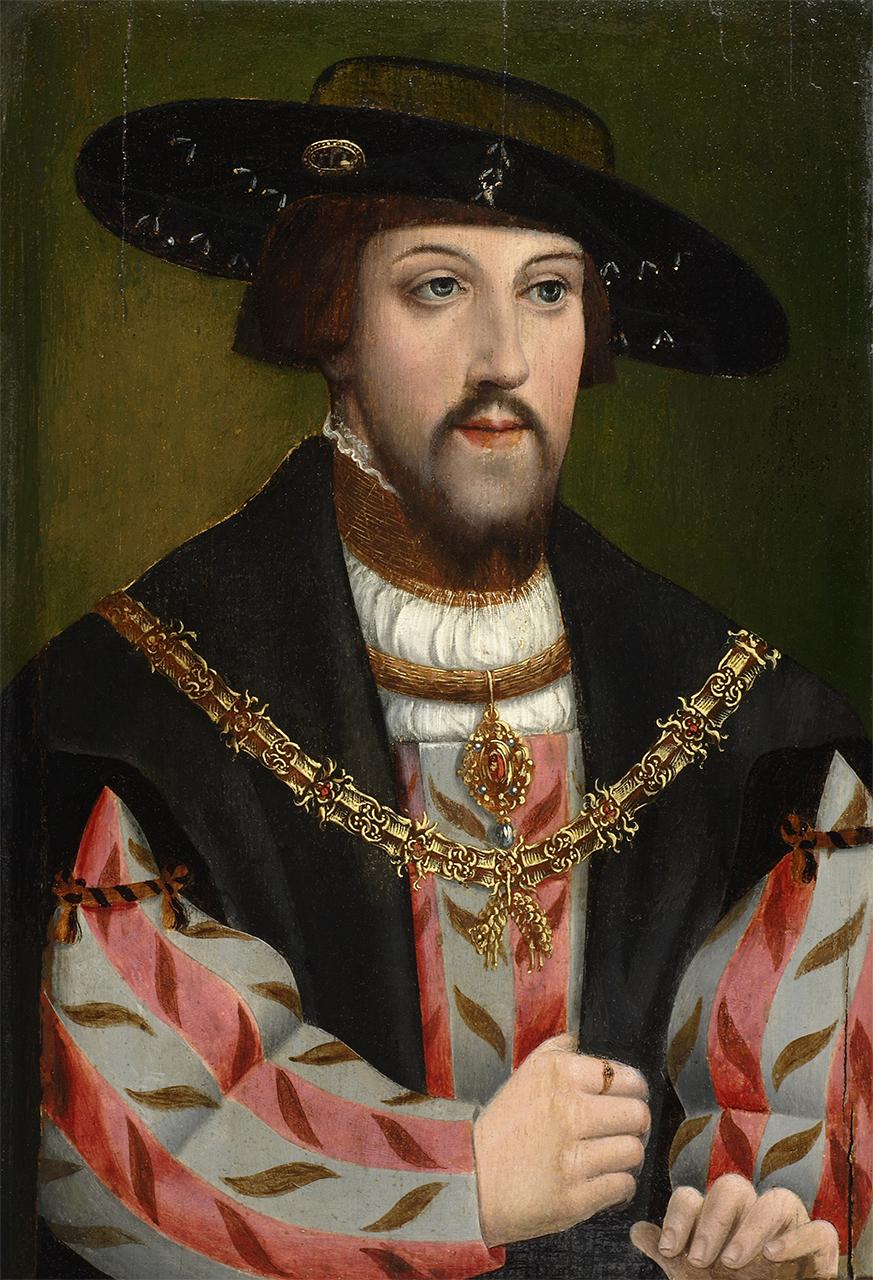
First half of the 16th century, unknown Flemish painter, oil on panel
A large number of portraits of the Jagiellonian king, who died young at the Battle of Mohács, survive in Europe because his widow, Queen Mary, as the esteemed governor of Habsburg Netherland, long outlived her husband. According to sources, she ordered a number of portraits of herself and her ex-husband, and as they showed the dowager queen as older, Louis could not have been painted as a young man together with her or in the portrait's couplet. This is how the older, fuller-faced and more bearded portrait of the king, who died at the age of 20, whose youthful portraits we know from the paintings of Bernhard Strigel (1460–1528) and Hans Krell (c.1495–1586) (KHM, Vienna), came to be. In the painting, Louis wears the large-brimmed flat hat typical of his late portraits. His velvet robe bears the chain of the Order of the Golden Fleece, which he received through the Habsburg-Jagiellonian double marriage treaty of 1515.
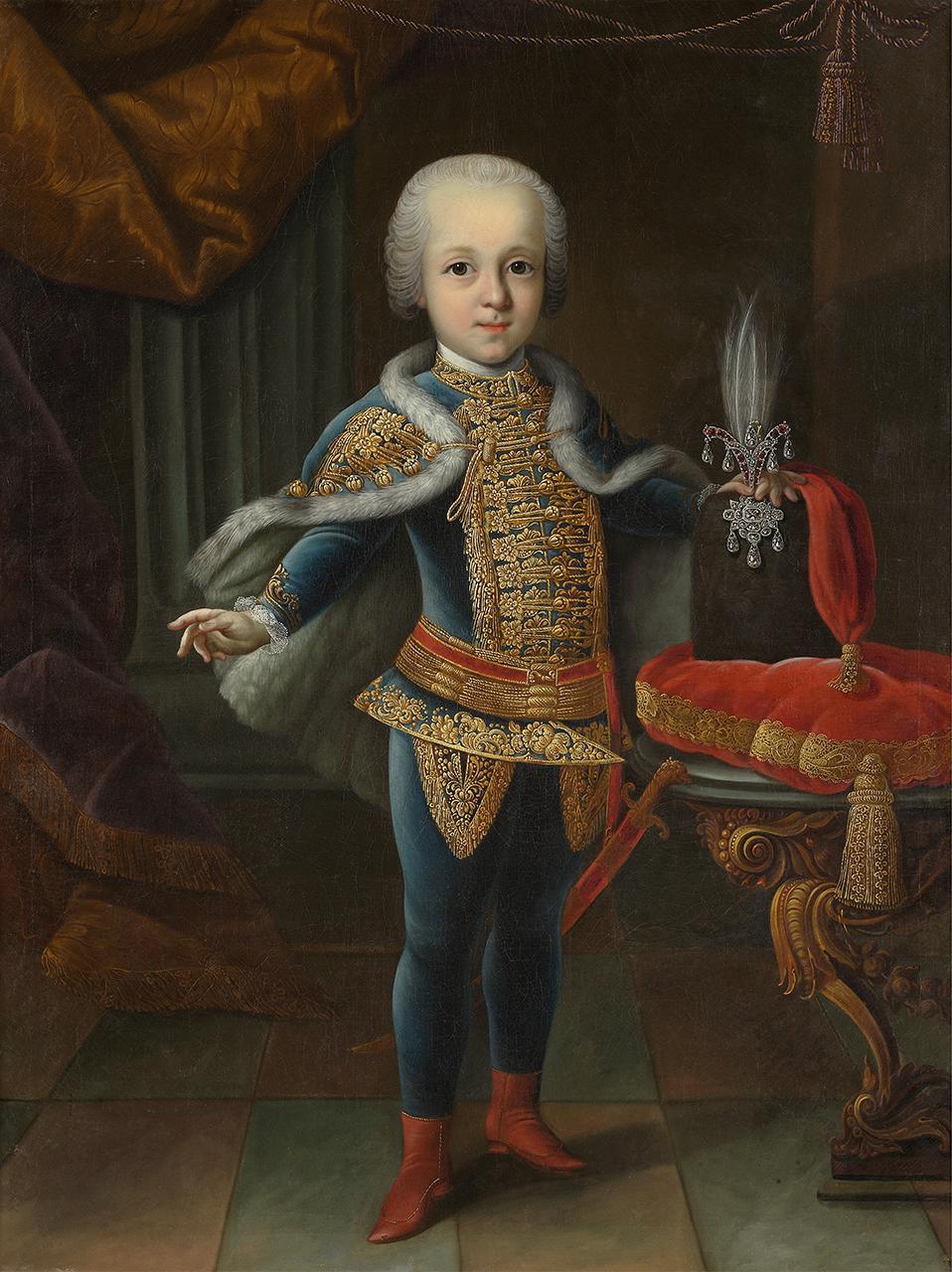
Unknown painter, oil on canvas; deposited by the Csáky family in the Hungarian National Museum
The portrait is the most common and most popular type of painting in 18th-century Hungarian painting. The form of Hungarian portrait painting, which developed and became widespread in the 17th century, emerged in the aristocratic ancestral galleries. In the country, which was split into three parts, it was not so much the royal court as the noble courts that carried the tradition of portraiture, in which the portraits of ancestors and family members, with their distinctly Hungarian costumes, were not only representative of the family but also of the noble nation. In this style of ancestral gallery what came to the fore in times of war was not the individuality of the person depicted, but his or her status in society and noble virtues, like valour. In the full-length portraits in full dress, insignia (e.g. decorative weapons, jewellery, medals, documents) played a greater role than the human portraits, which were expected to be only physiognomically similar. The influence of courtly art, which was increasingly becoming a model to be followed by aristocratic families, is shown in a painting from 1749 by Maria Theresa's court painter, a follower of the Swedish-born Martin van Meytens, depicting the child of the north Hungarian count's family, József Csáky, at the age of four. The future vice-chancellor appears in the pictures of the archdukes of the royal family as a small adult, older than his age, with the same attire and setting as the representative Baroque portraits of the aristocracy. The idealised but well-elaborated child's face and the schematic setting with console table, columns and drapery, seek to emphasize the image of an influential aristocrat, even as a child, while putting childlike spirit and individual features quite into the background.
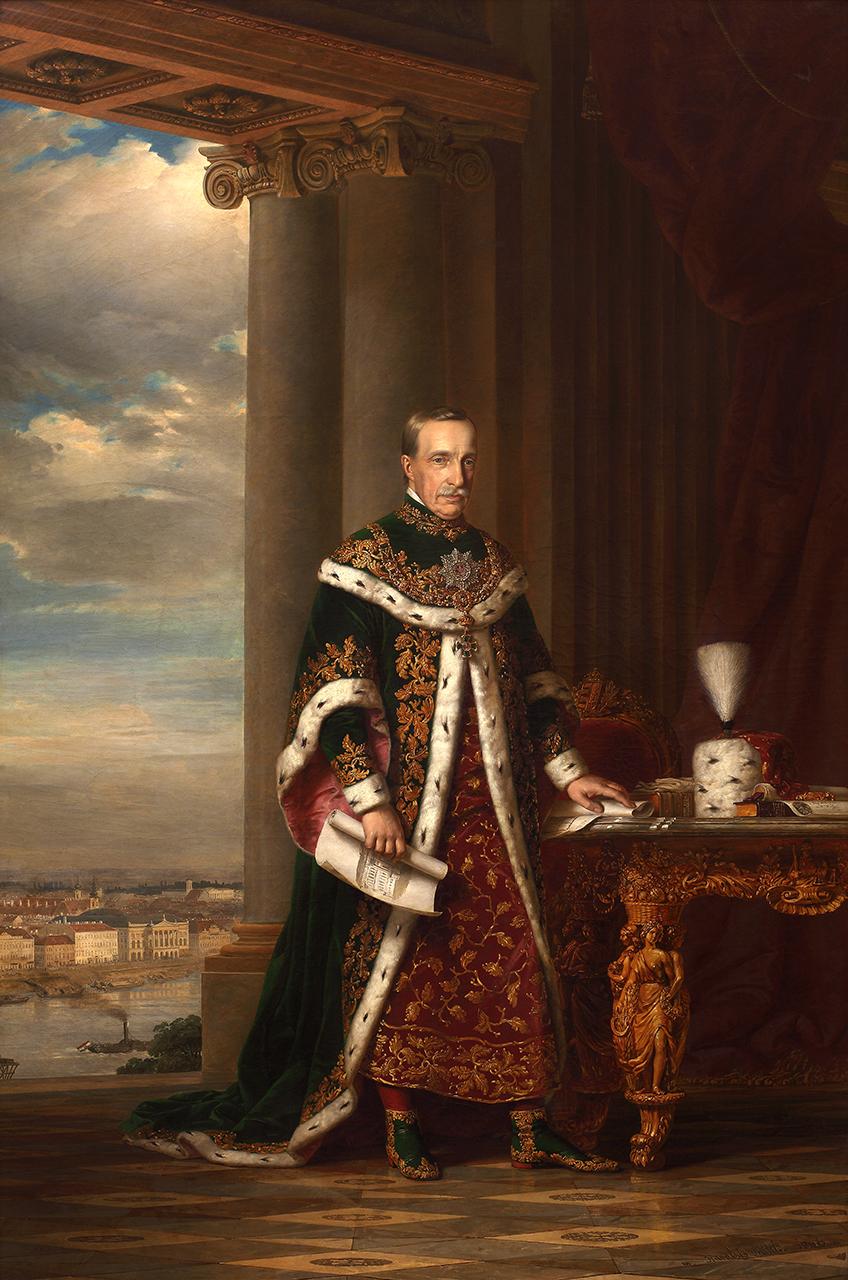
Miklós Barabás (1810–1898), oil on canvas
Archduke Joseph, Palatine of Hungary at the head of the Beautification Commission, did much to make Pest a modern capital. The Association for the Establishment of a National Picture Gallery, which was founded in 1845, launched a national collection for his portrait in its first resolution. This act was intended to express their gratitude to and to perpetuate the memory of the Palatine, who, as director, had taken the affairs of the National Museum to heart and, as the main patron, had worked out and enacted the museum's plans from 1808, thus providing a legal framework for the foundation of the museum by Count Ferenc Széchényi in 1802. A representative portrait of Széchényi the founder by Johann Ender was already in the museum's possession, thanks to a generous donation from his sons in 1823. Commissioned from Miklós Barabás in 1846 after a successful fundraising, the painting was also important because it was intended to be in the main room in the Palatine Joseph National Picture Gallery, to be opened in the new museum building. Barabás fulfilled the client's wishes perfectly, painting a restrained but appropriately solemn large portrait. The fictitious setting is reminiscent of the Buda Castle, where the apartments of the Palatine were located. In the neo-classical room, next to a richly decorated Baroque table stands the bare-headed and ceremonially dressed Palatine, holding in his hands a plan of the façade of the National Museum. The colonnaded opening offers a very realistic view of the reform-era Danube bank in Pest, with Mihály Pollack's famous Redout building, which fell into ruins during the siege of Buda in 1849. The palatine's ceremonially dressed picture had a long afterlife: it served as a model for several later depictions. On Johann Halbig's 1859 public bronze statue, which was erected only ten years later on József Nádor Square, the palatine also wears the ceremonial garment, and this is how Mór Than painted him as the founder in the fresco on the main staircase of the National Museum in 1874–75.
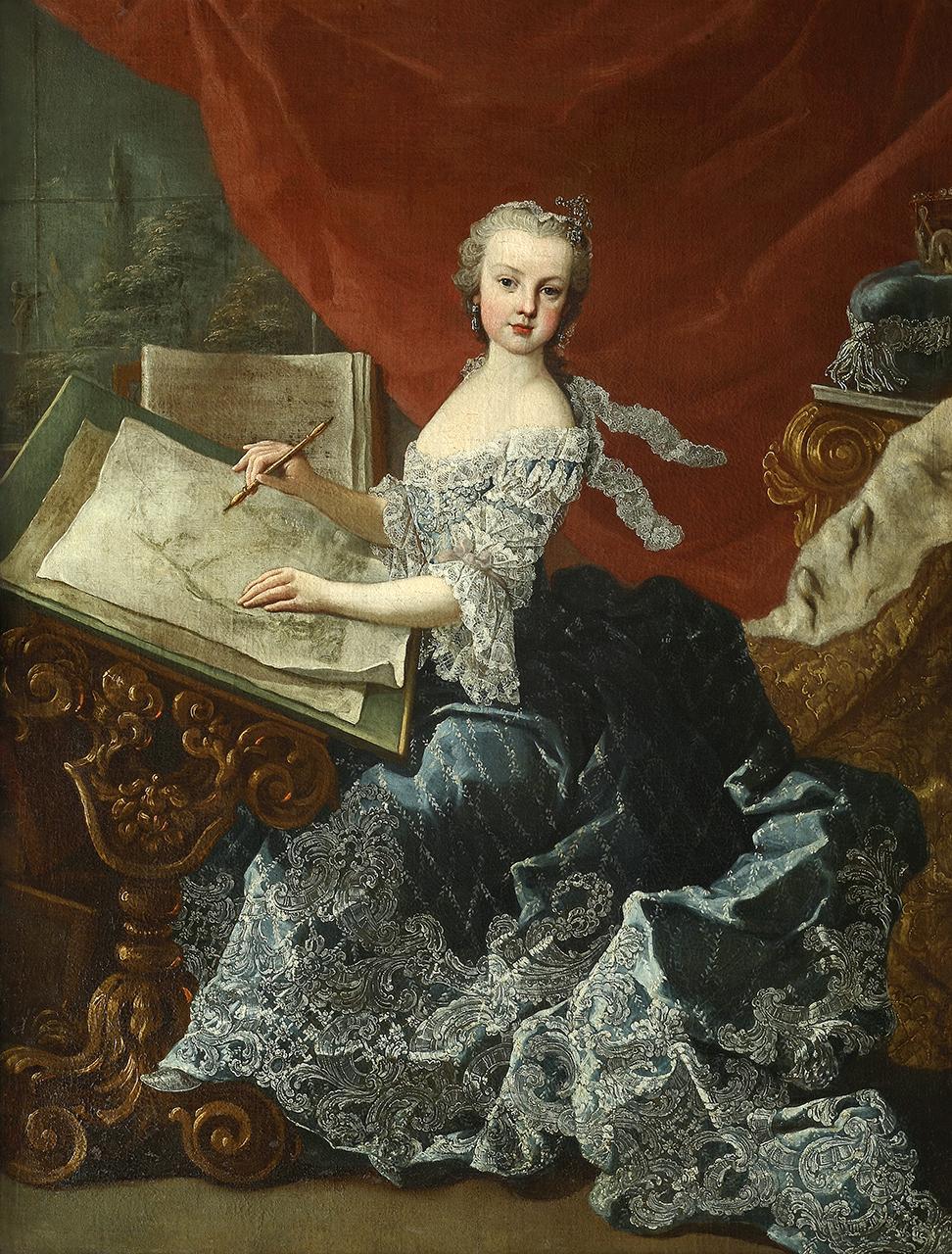
Workshop of Martin van Meytens, oil on canvas
Maria Christina (family nickname "Mimi") was born on 13 May 1742 in Vienna, the fifth child of Emperor Franz I of Lotharingia and Queen Maria Theresa of Hungary. Her mother's admittedly dearest daughter was characterised by intelligence, affection and – especially as a painter – considerable artistic talent. It was customary for all the daughters of the ruling family of the period to receive an education in art, but among them, Maria Christina was the most advanced in terms of artistic talent. She found an equal partner in her art patronage ambitions in her husband, Archduke Albert of Saxe-Teschen, with whom she created the dynasty's largest collection of graphic art, the basis of the present-day Albertina. After her death (Vienna, 24 June 1798), her husband commissioned a huge monument from Albert Antonio Canova to be erected in the Church of Saint Augustine near the Hofburg, entitled "Uxori optimae" (To the best spouse). The painting shows the Archduchess, in her teens, sitting at a drawing table with a chalk crayon in her hand. On the paper in front of her is a sketch of a profile portrait. Behind her is the crown of the Archduchy of Austria on a blue velvet cushion, and an ermine-lined golden brocade robe falling to the ground. In the background, a window over a music stand on the left overlooks the garden, while a red brocade curtain covers the wall on the right. The decorative, elaborate style of the depiction fits in well with the work of the court painter Martin van Meytens (from 1732 a painter in Vienna), who created a court workshop specialised in portraying members of the ruling dynasty and their representative life events in somewhat monotonous but technically demanding renderings. Several of the paintings of family life depicting Maria Christina while painting are also known. One of them is an intimate table setting of Maria Theresa, the later emperor Joseph II and his wife, and Maria Christina, while the other, more representative painting, is where she presents a portrait of his father Emperor Franz I to the entire imperial family, a version of which is preserved in the Kunsthistorisches Museum.
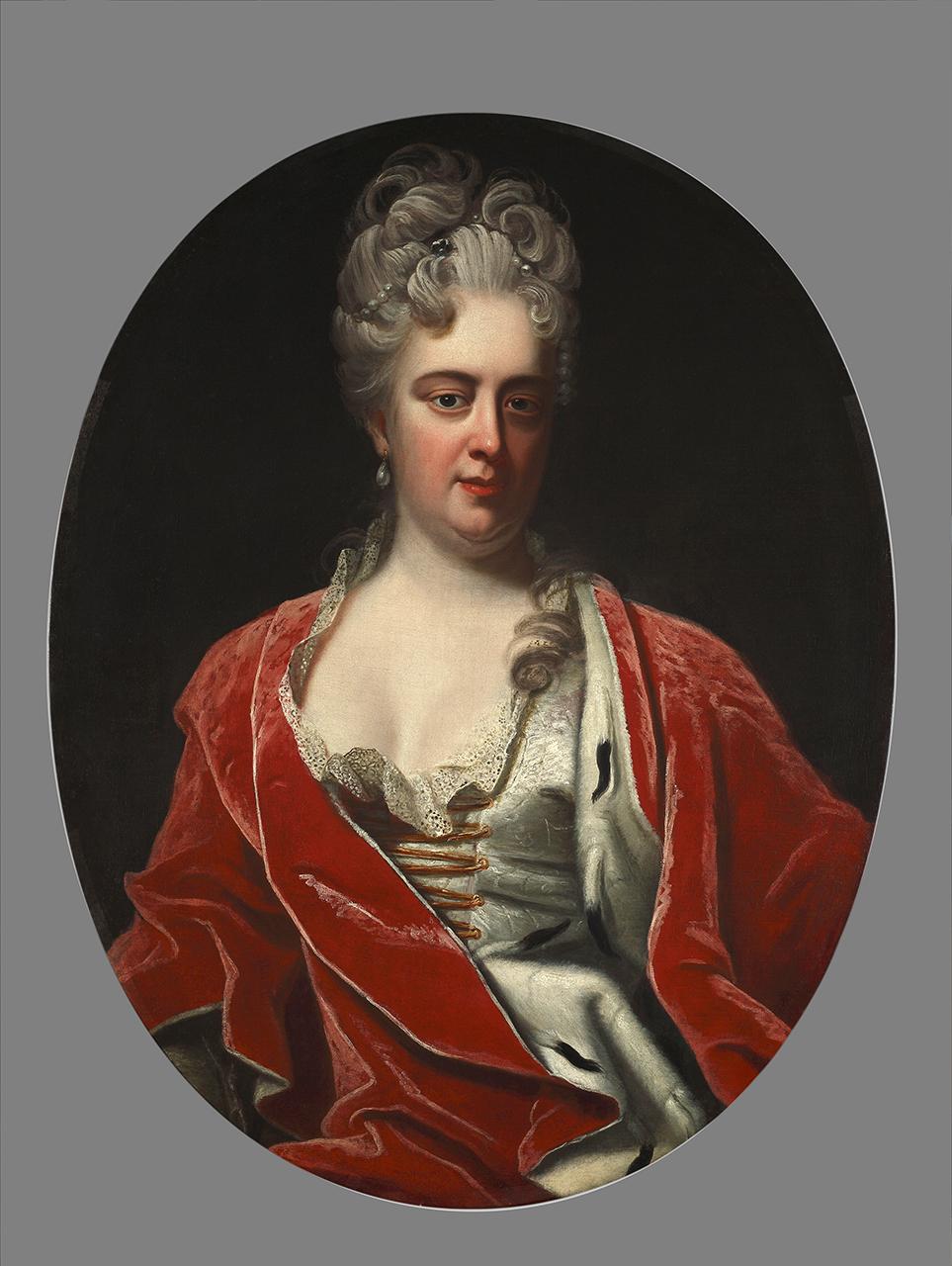
David Richter the elder (1662–1735), oil on canvas
A Swedish-born portrait painter, David Richter worked as a court painter in Berlin and Vienna after studying in Rome. The inscription on the back of the portrait of the princess indicates that it was painted in 1704, which makes the Vienna location likely. The oval painting shows the princess from the waist up, her figure covered by a brilliantly painted, substantial-looking, ermine-lined robe. The subdued painterliness of the face, which emerges from the neutral dark background, confirms the well-done characterisation. The lifelike rendering and high quality of the painting suggests that it was painted directly after the model. The same cannot be said of the portrait of the prince. The somewhat static setting and the less pronounced characterisation of the face suggest that the portrait was not painted after life, but that Richter used some kind of prefiguration that we do not know. This is confirmed by the fact that there are no records of the painter having visited Hungary and met Rákóczi during the War of Independence. Nevertheless, the authenticity of the portrait is beyond dispute, and its significance lies in the fact that it is the earliest authentic portrait of the princely couple that has survived. We do not know whether the pictures had a direct influence on the pair of portraits painted three years later by Adam Mányoki, as a court artist of the prince.
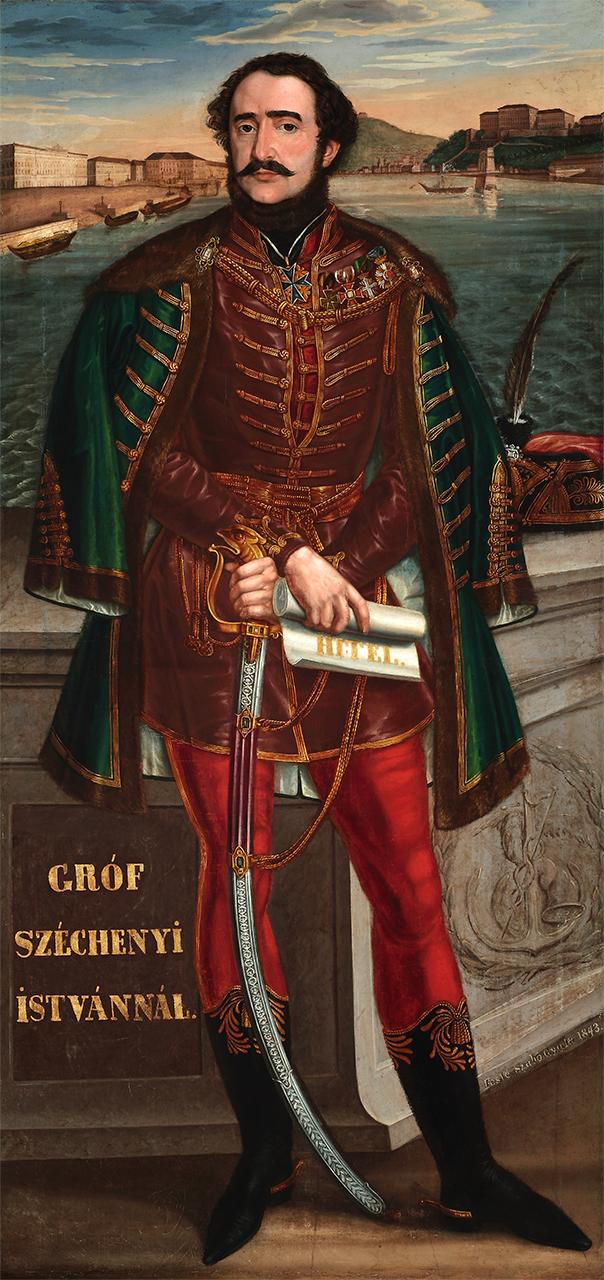
Gyula Szabó, oil on canvas
Széchenyi's career and popularity reached its peak in the early 1840s. By this time, many of his ideas had already been realized and his modernization plans were widely known. After the foundation stone of the Chain Bridge was laid in 1842, the uncertainties surrounding its construction seemed to be resolved, and the Count's figure became synonymous with the promise of the future bridge. The artist, Gyula Szabó – whose only painting we know of is this, and there's no further information about his life, either – places Széchenyi in front of the view of the planned bridge. This is the first time to link him visually with his most famous project. In this representative portrait, reminiscent of ancestral galleries, Széchenyi wears a mauve-coloured braided dolman and a fur-trimmed green velvet mente (pelisse). His decorations are clearly identifiable on his neck and chest: the Prussian Pour le Mérite, the Austrian Army Cross, the Russian Order of St Vladimir, the Knight's Cross of the Order of St Maurice and St Lazarus of Sardinia and the Cross of Merit of St Ferdinand of Naples. In his left hand he holds a ceremonial eagle-headed saber with a special hilt, while in his right he holds a scroll inscribed with his first famous work, Credit. The pictorial prototype was a lithograph by Franz Eybl made a year earlier, which became widely known when distributed as a separate sheet. On one side of the fictitious frontispiece, which is set in the middle of the Danube, a laurel wreath, an anchor, a cornucopia and a staff of Mercury allude to the hope for prosperity and trade, while on the other side, the curious inscription – "At the home of Count István Széchenyi" – discovered during the recent restoration, may suggest that it was he who made it all happen in our country. The model for the background view was Carl Mahlknecht's steel engraving of 1839, based directly on the view plan approved by the Bridge Committee. The combined depiction of Széchényi and the Chain Bridge was the subject of many works of art later. The most monumental of these is Miklós Barabás' painting for the County Hall in Pest, seven years after the Count's death. The artist's career had long been related with Széchenyi, who, at the request of the Bihar County, recommended him to paint his portrait in 1836: "a very fortunate coincidence brought a very brave and skilful painter among us only a short time ago. His name is Miklós Barabás, [...] I can recommend, and I dare say, that the Esteemed Orders [...], while they appreciate István Széchenyi, and if possible, bind the sculptor Miklós Barabás to themselves with even stronger chains of loyality, will also support and promote the son of our country." Later that year, the artist painted his portrait for the county of Hont (now in the museum of Banská Štiavnica), and in 1848, as a minister (Historical Picture Gallery), and also made several lithographs of him.