The Weapon Collection of the Hungarian National Museum is one of the oldest in the institution. Dating from the 11th century to the present day, the collection houses nearly 10,600 artefacts. The most significant among the cold weapons is the collection of cold steel, i.e. bladed and pointed weapons. The variety of melée weapons, polearms, as well as protective weapons is also large. As regards small arms, the collection also includes military, hunting and sporting weapons from the late 15th to the second half of the 20th century. Not only weapons, but also harnesses and battle standards are kept in the collection. Among the artefacts there are several weapons and relics of many historical figures, including King Louis II, György II Rákóczi and János Kemény, Kings Joseph I and Joseph II, András Hadik, Lajos Kossuth, Artur Görgei, Franz Joseph I and Charles IV, and Miklós Horthy.
Contact Dr. Ákos Sánta, santa.akos@mnm.hu Tel.
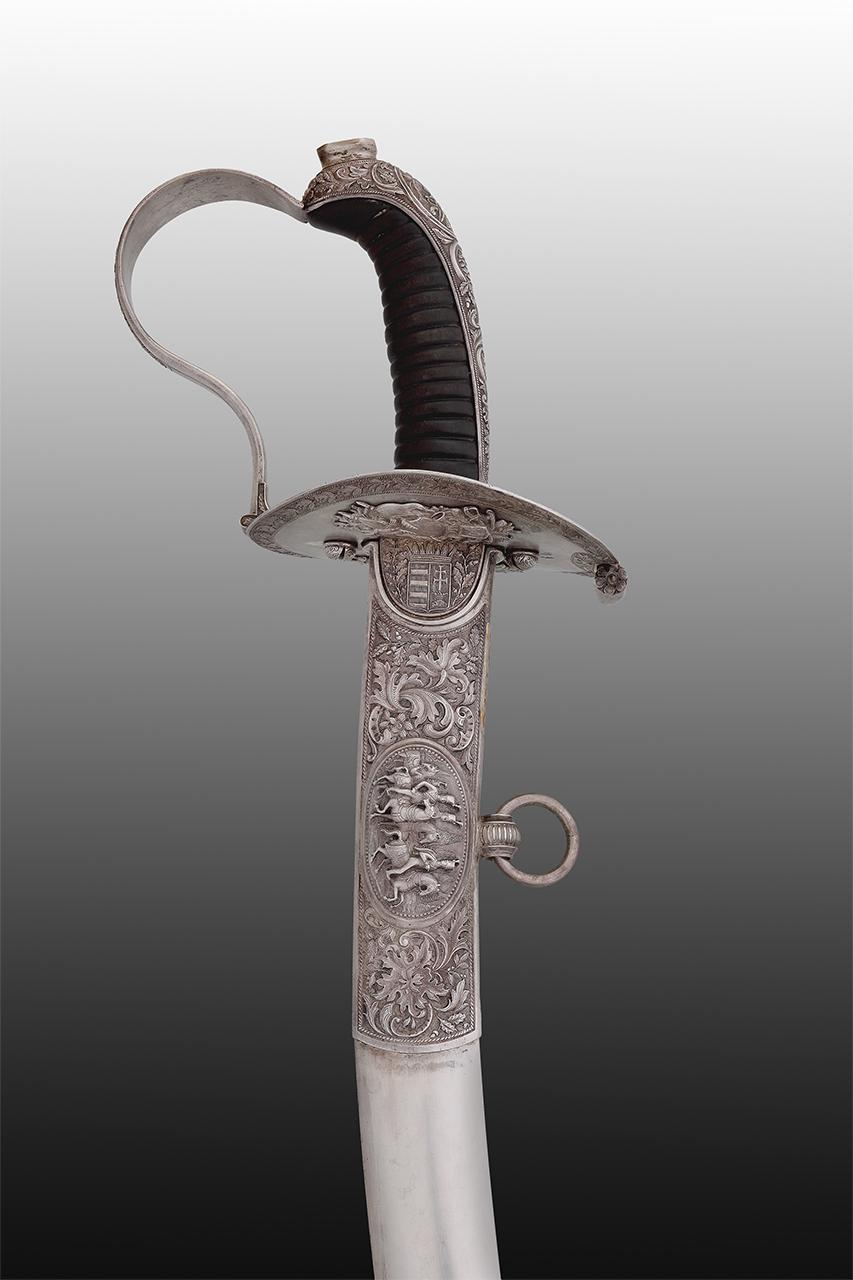
The ceremonial sabre of Count Ferenc Haller, an outstanding figure of the Hungarian noble bodyguard. Made in 1840 by H. Haussmann in Vienna. On both sides of the blade there is a dedication to Count Ferenc Haller, Captain of the Guard, and a list of the donating guards. The year 1842 is inscribed on the hilt. Under its silver crossguard, the broad oval écusson plate bears the coat of arms of Hungary and Transylvania. The pommel is decorated with Haller's coat of arms engraved in topaz.
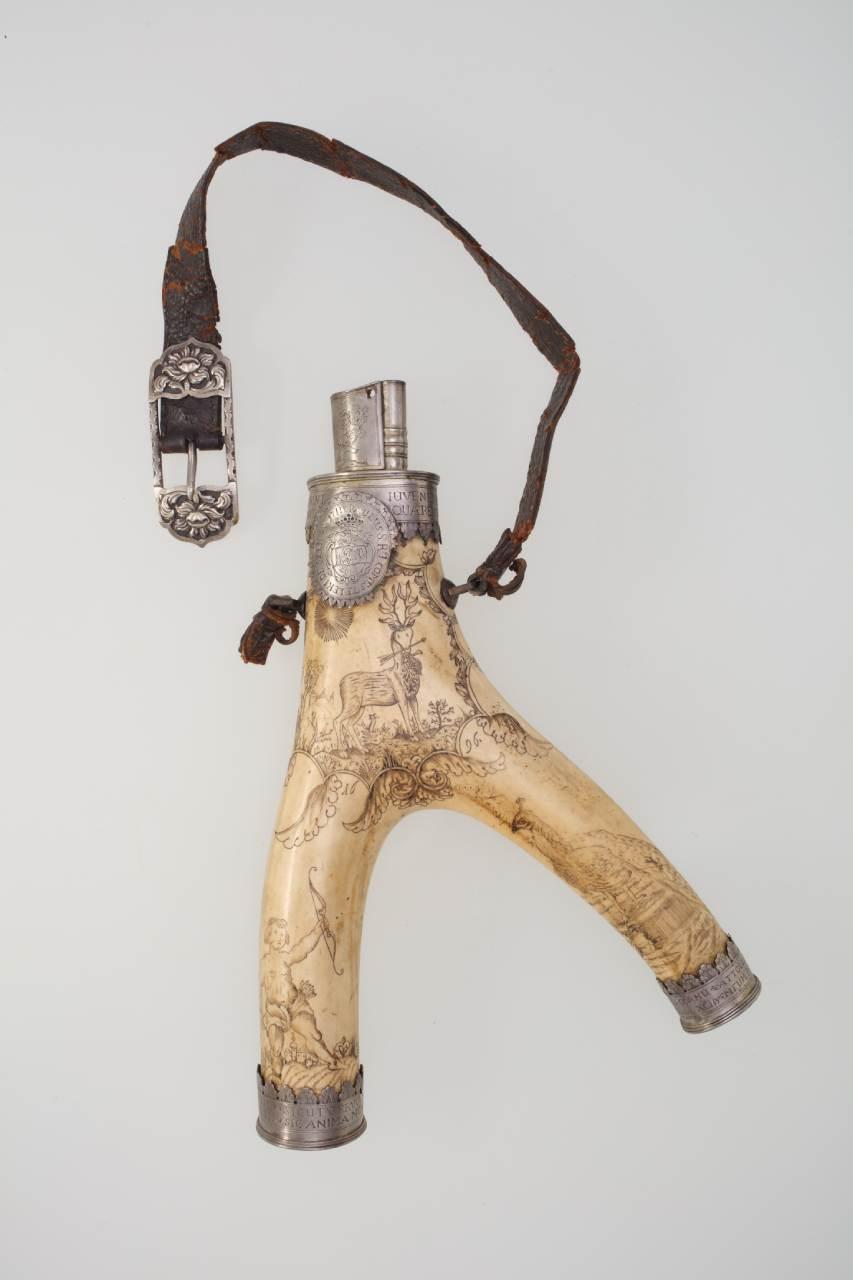
The powder flask was an indispensable accessory for the black powder handguns. The black powder was dispensed from it into the barrel of the gun. The finely polished deer-antler powder flask, richly decorated with animal figures, plants, a castle and the figure of Cupid, with the date 1696 on the top used to be in the possession of the Counts Teleki. Articles crafted for noble commissioners often bore the family coat of arms. The bifurcation of the two-pronged antler crown bears the coat of arms of the Teleki family. The dispenser and the "caps" closing the ends of the stems were mounted in 1711 . All of these are silversmith parts decorated with engravings. The original, silver buckled shoulder strap of the gunpowder flask has surprisingly survived.
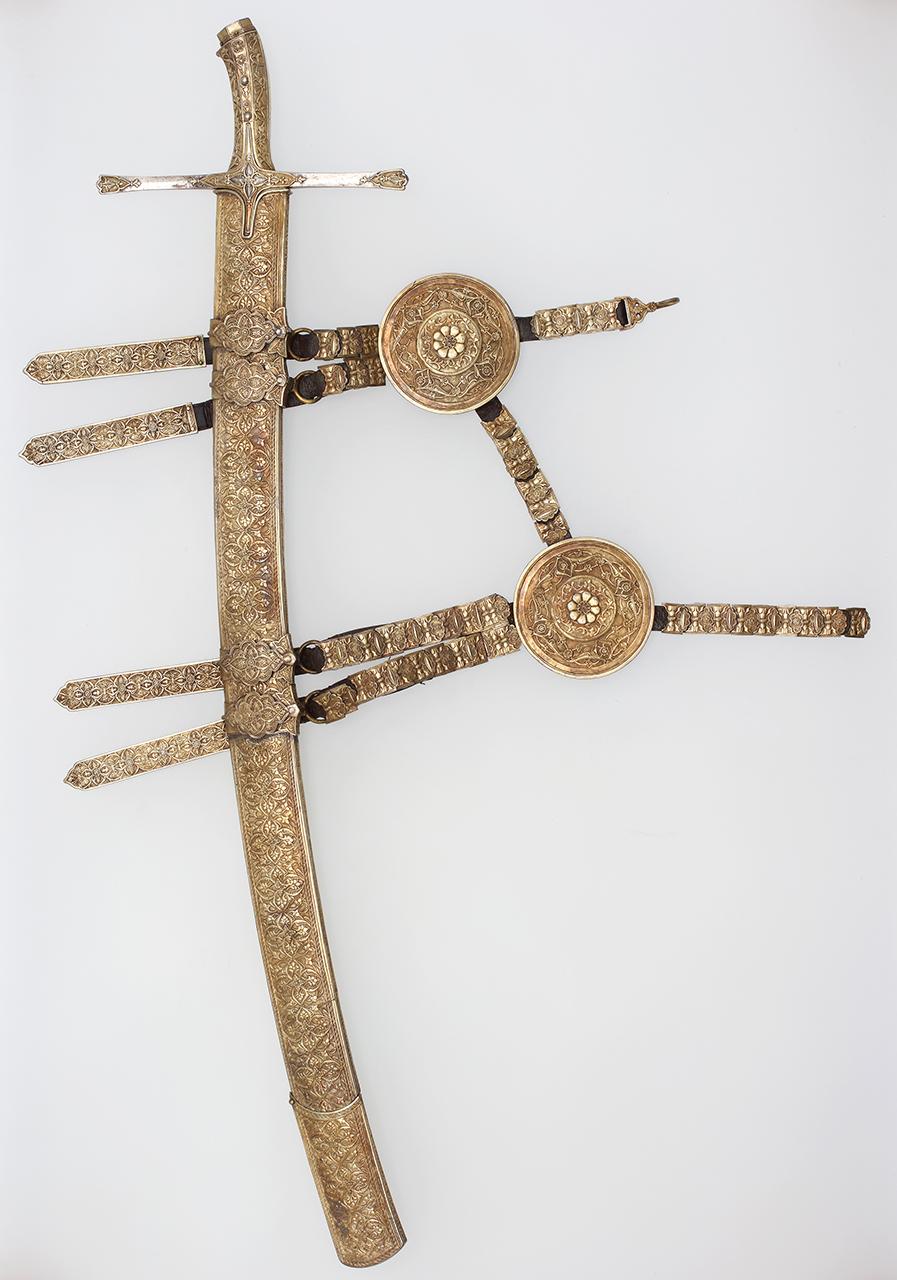
A fine, smooth-bladed sabre with a point, from the property of Archduke Ferdinand II of Tyrol. The entire surface of the gilded silver plate of this work of art is decorated in the characteristic Ottoman style, consisting of lotus buds and flowers on vine branches and elongated leaves with pointed tips. Despite the engraved date of 1514, the sabre was made in the mid-16th century.
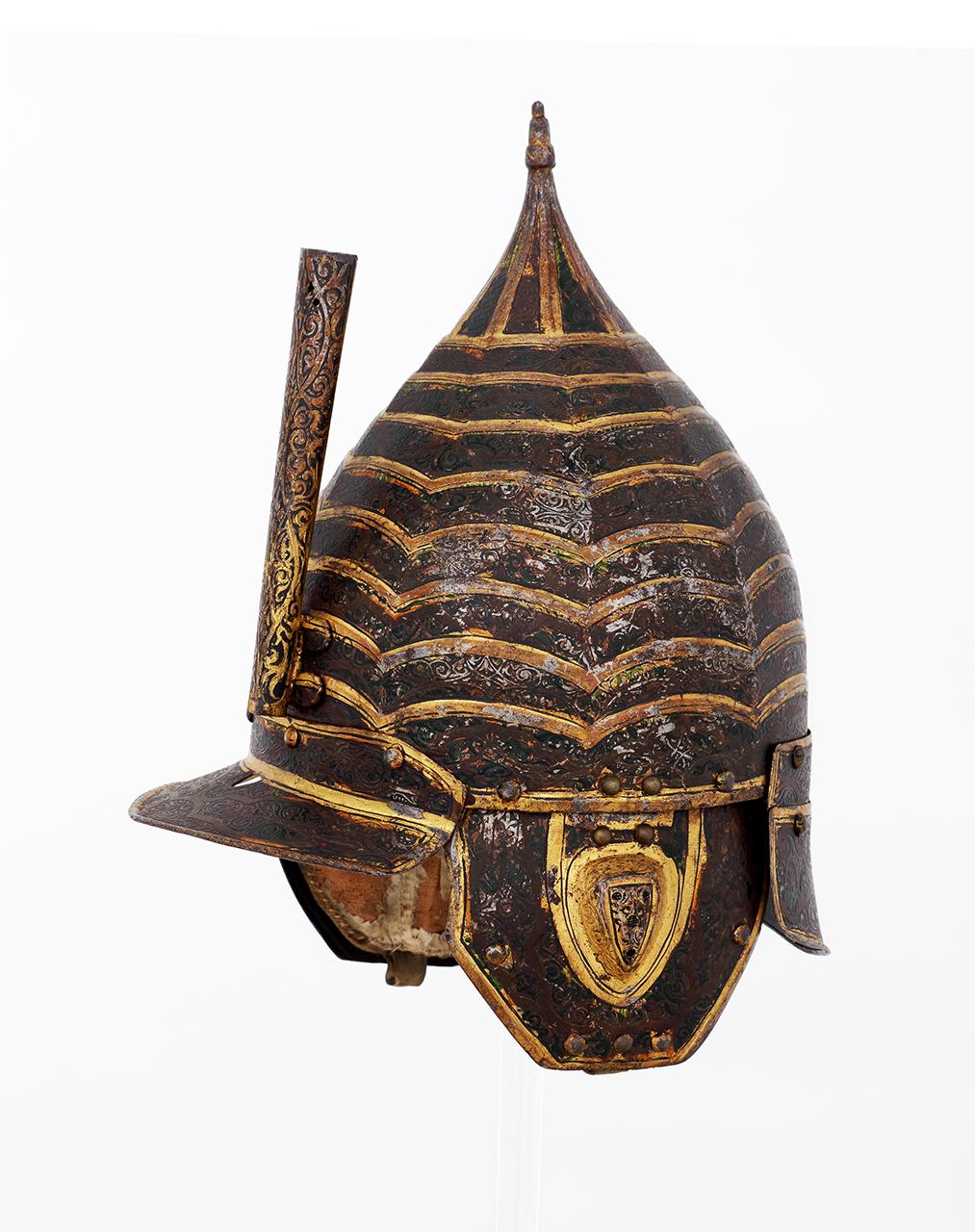
Ottoman-Turkish style hussar tournament helmet from the mid-16th century. The original lining inside the bell-shaped helmet ending in a pointed, acorn-shaped tip has been preserved.
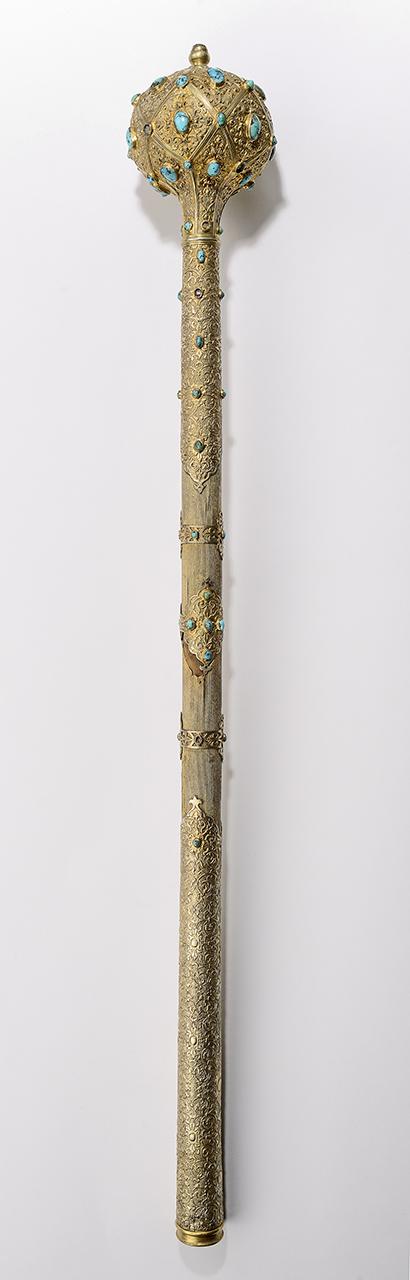
The mace of István Báthory, Prince of Transylvania and King of Poland, decorated with turquoise, made of gilded silver and wood. In the middle of each field delimited by bands and shaped into cartouches of the cast mace head a large turquoise is set surrounded by daisies. It was probably made in Kolozsvár (today: Cluj-Napoca, Romania) in the second half of the 16th century.
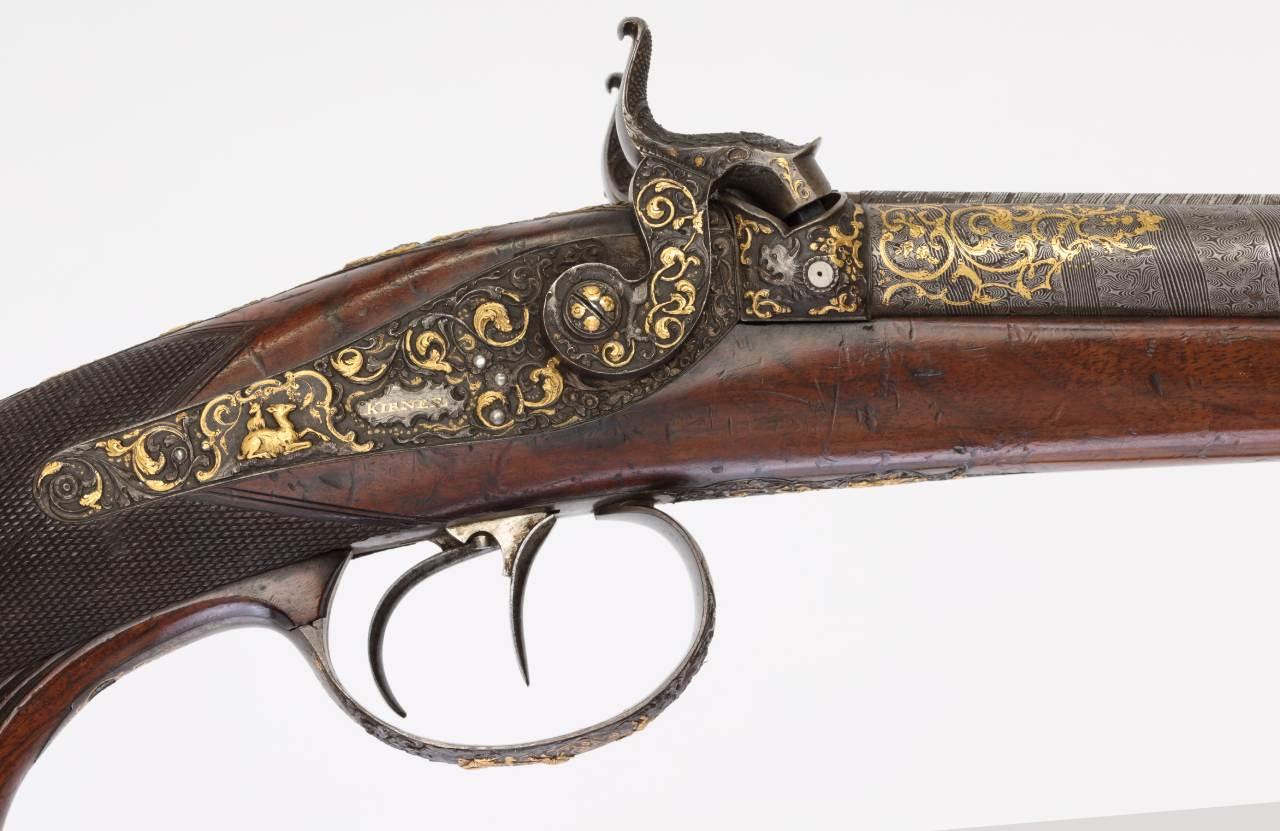
The collection of rifles made by different generations of the Kirner family is not easy to choose from. The "selected" percussion shotgun, with two hollow-bore, 16 mm laminette damascus barrel, is a lavishly decorated example. All metal parts except the barrels, the buttstock and the triggers are engraved with gold featuring richly decorated vines and leafy floral ornamentation. On one of the lockplates, the figure of a deer stag lying with his calf behind him appears next to the name of Master KIRNER. On its broad beak-tail, figures of crossbow hunters appear rowing in a boat. The rifle rack is decorated with the gold-plated figure of three fauns. It is a set-trigger mechanism rifle.
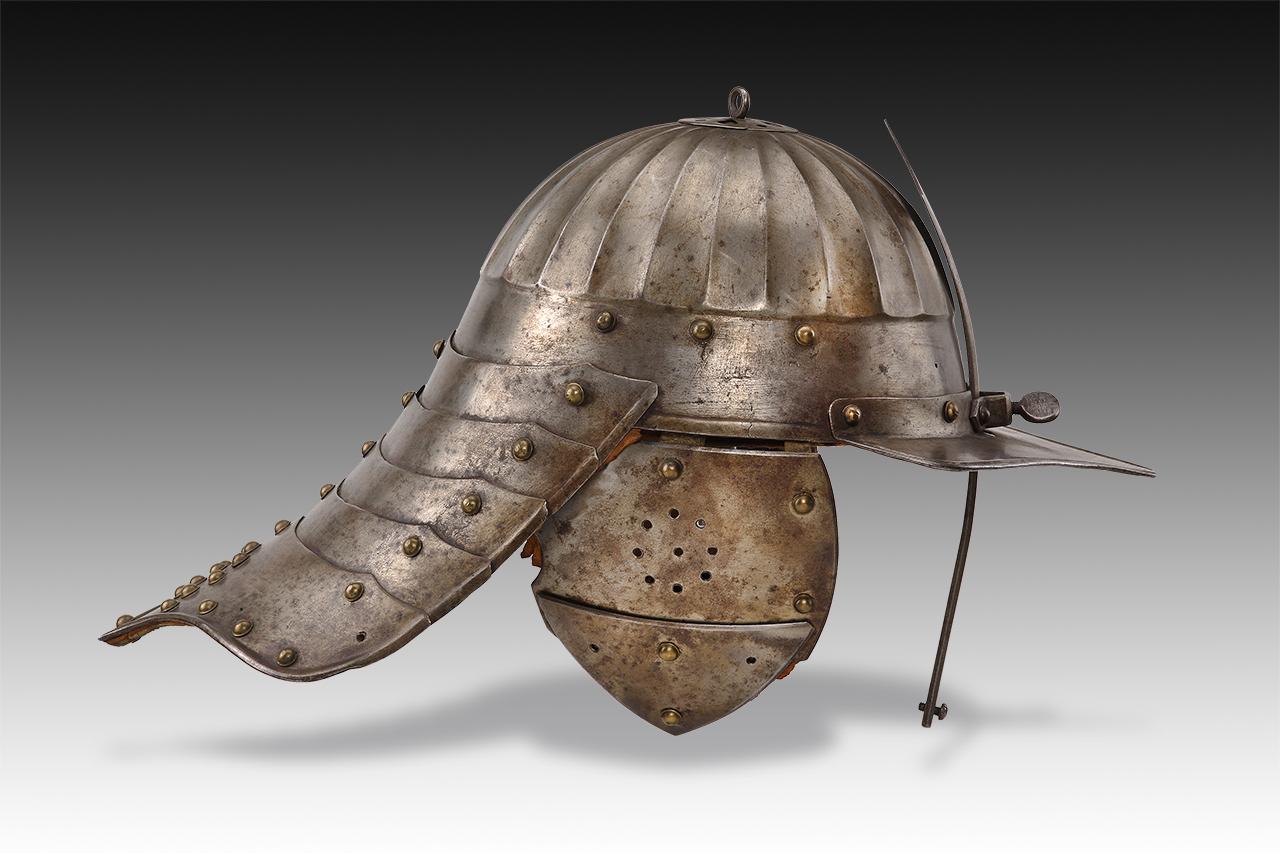
The helmet of Turkish origin, with its characteristic nose, face and neck protectors, was adapted to the needs of mounted combat. The sides of the face were protected by wide fold-down ear flaps, the back of the head by a series of "crab tail" plates. Frontal blows from different angles were fended off by the helmet's visor, while horizontal blows were warded off by the movable nasal-guard. Conical versions were in use from the mid-16th century. Later on, the high helmet bell became more and more rounded, and in the middle of the 17th century this shape became the headgear of the Imperial troops. The late example in the picture is hemispherical in shape, with a ribbed helmet bell, a neck guard and an eyeshade. Its rivets attached the leather lining to the helmet.
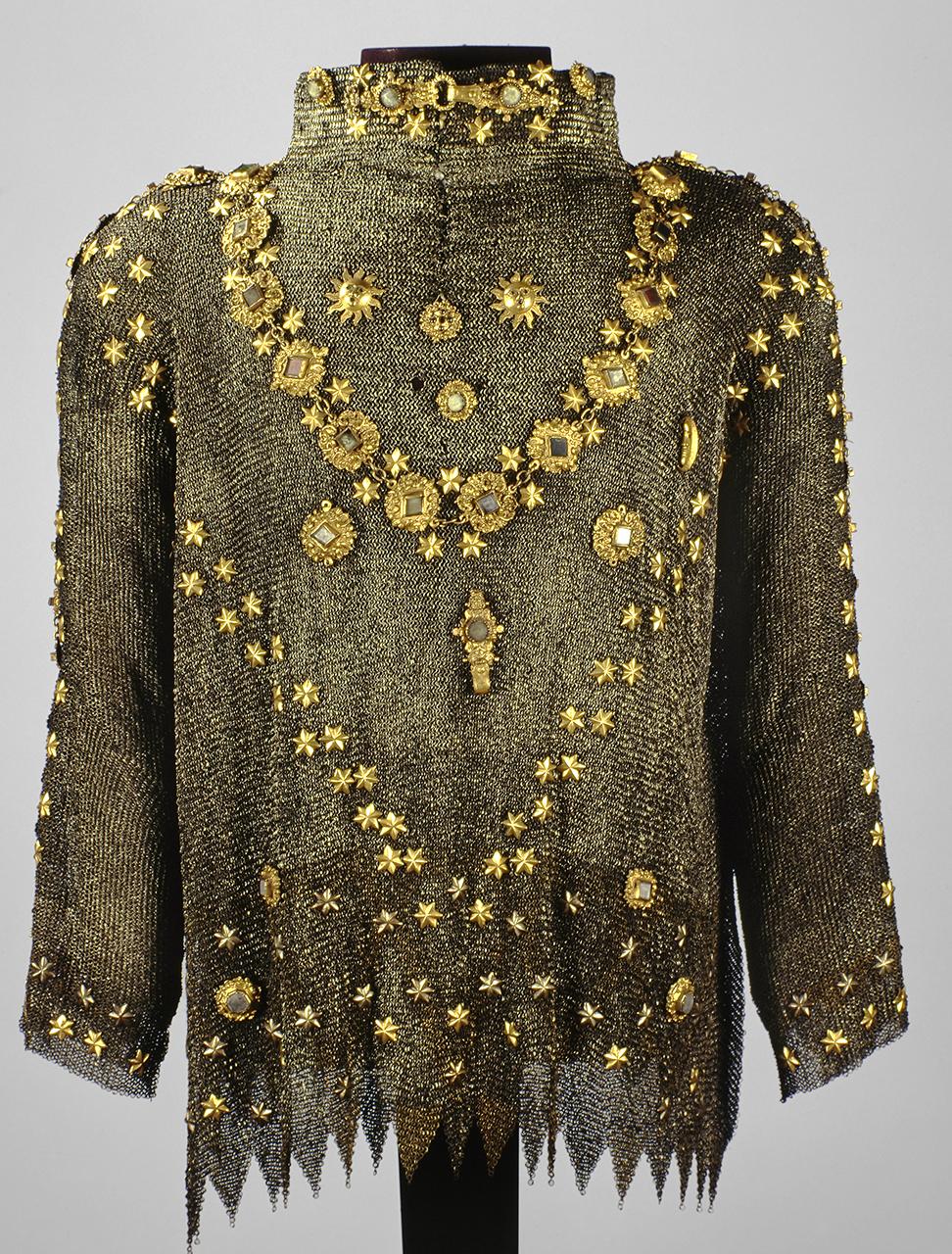
The 0.4 cm wide, silver-plated rings of the ceremonial chain mail of Transylvanian Prince György II Rákóczi are riveted and welded. The neck is decorated with two pairs of ornate glass paste clasps, while on the chest there is a gold-plated and glass necklace. A double 'V' shaped row of stars runs from the shoulder down to the bottom of the chain mail which also features cast and gilded suns and moons inlaid with rubies. Along the sleeve hems runs a row of brooches linked by a chain and framed on either side by a row of stars.
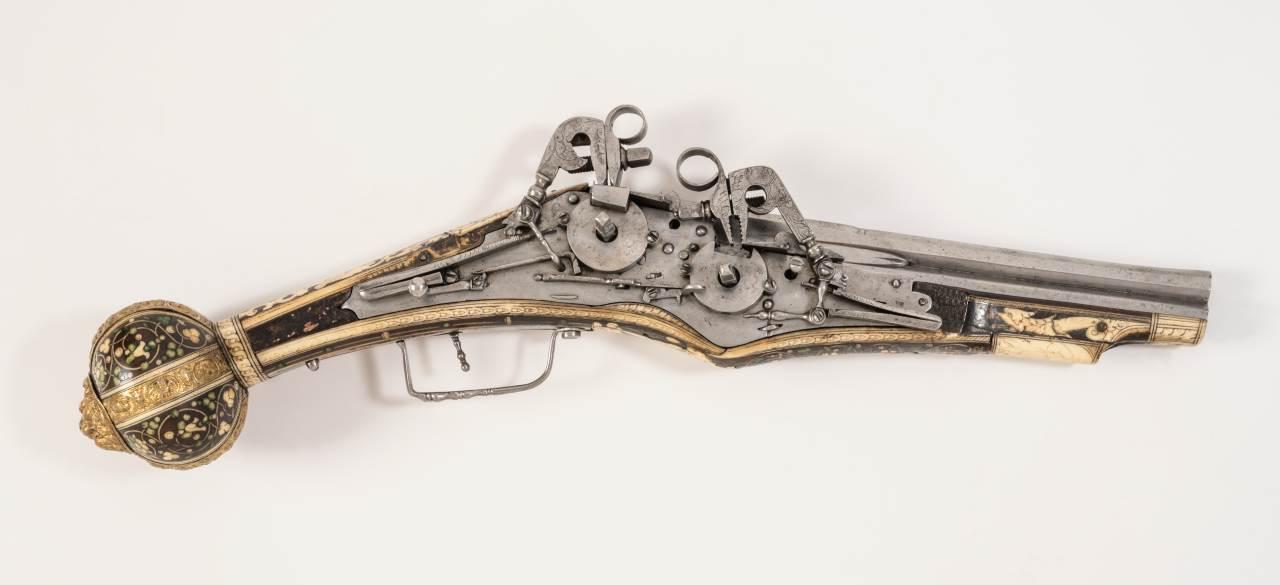
In the 16th and 18th centuries, pistols were also used for hunting. Hunters often shot their game while sitting in the saddle, especially during horse chase hunts, when they would take close-up shots at their target from horseback. The late 16th-century muzzle-loading double-barrelled hunting pistol used by aristocrats, is shown here decorated with a boar hunt scene inlaid with bone and mother-of-pearl. Its grip is decorated with gilded silver bands and a lion's head.
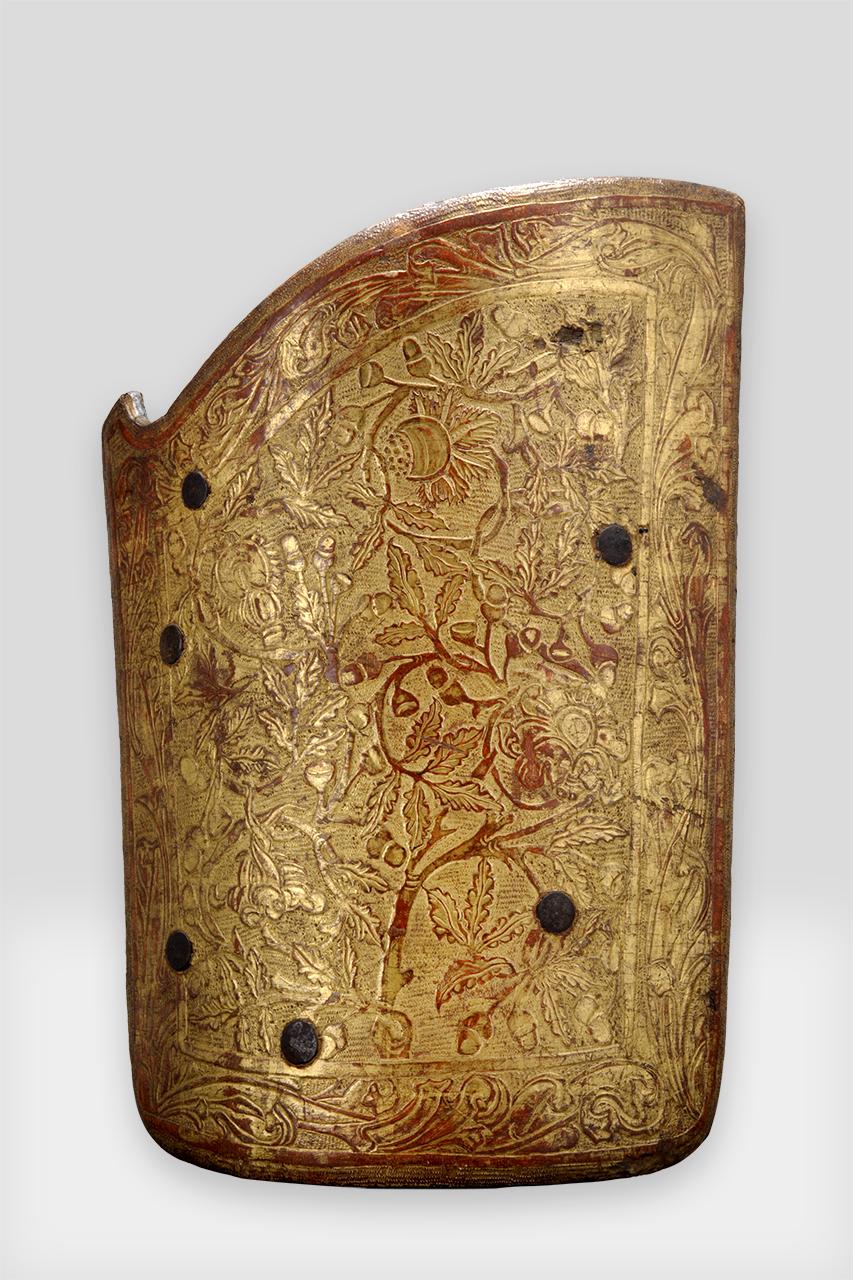
In 1933, the disc shield was acquired by the Hungarian National Museum as one of the art treasures of Vienna. The square-shaped, bulging shield is made of birch wood, it is 1.2 cm thick, with a slightly curving upper part and a cut-out at the top for supporting the lance. The exterior is covered with a layer of gilded plaster decorated with oak branches with acorns, pomegranates and acanthus leaves. It used to be fitted with a double strap, which allowed it to be hung around the neck or worn on the back by hussars.
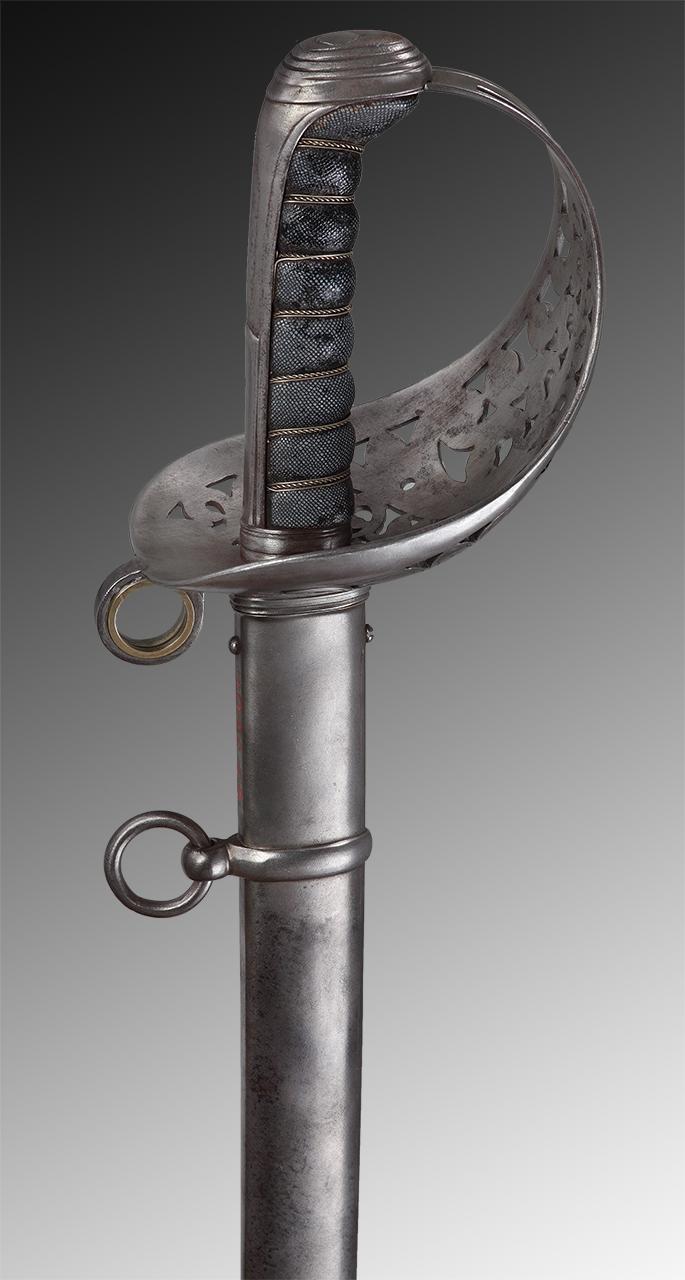
Artur Görgei's 1845 M cavalry officer's sabre, with a magnifying glass in the hilt, with which the general – famous for his short sightedness – read maps. On the double-edged blade there is an inscription "For Homeland, Freedom and King", as well as the Hungarian coat of arms, and the date "15 March 1848" and war trophies. The length of the sabre is 101.5 cm
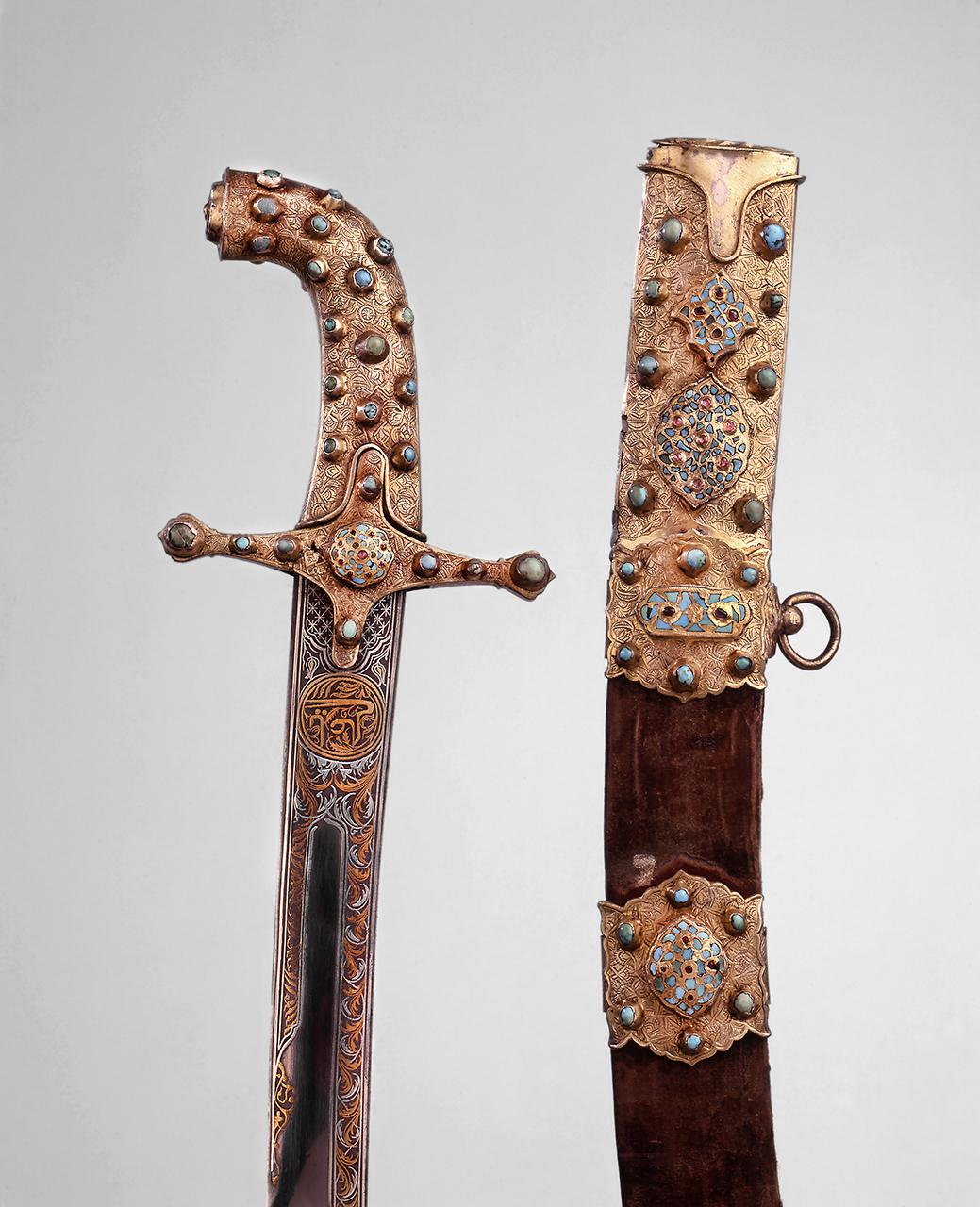
The sabre, richly decorated with gilded silver, gold, rubies and turquoise, made in the Ottoman Empire, was donated to the collection by Ferenc Révay. Its curved double-edged blade has a wide groove in the centre surrounded by gold-plated sedge leaves and silver-plated lattice motifs. One of the blades bears the inscription O Ali! in gold. The centre of the sheath is covered with velvet.