The Hungarian National Museum's Tobacco History Collection was established in 1974 within the framework of the Modern History Department. However, pipes had been added to the museum's collection since the early 19th century. Its world-famous core collection consists of carved meerschaum pipes, the most beautiful examples of which are precious relics of 19th-century artistic craftsmanship. In addition, the collection includes popular clay, wood, and porcelain pipes, as well as pieces made of special materials (such as nautilus shell, silver, glass, and coral) that are worthy of display in a showcase. Pipe stems, table pipe racks, tobacco processing and storage equipment, fire-lighting tools, a few items related to cigar and cigarette smoking are also part of the collection, and so are supplementary documentation. All of these provide important insights into the lifestyles and customs of various social classes and groups from the 17th century to the early 20th century. Pipes were popular gifts, and finely crafted examples could express the status, good taste, and even political beliefs of their owners. The collection preserves the pipes of numerous historical figures as relics. Of particular importance are the objects documenting the history of the long tradition of domestic pipe making.
Contact: Dr. Anna Ridovics, ridovics.anna@hnm.hu
A historical relic of the reform era is the Zopf-style meerschaum pipe, which, according to the engraving on the silver plating, was given to Lajos Kossuth by István Kajdácsy as a token of respect in 1836 in Pozsony on the occasion of the Diet. It is a real rarity, as Kossuth's growing collection fell victim to the lawsuit started in 1837 due to the National Assembly Reports. His pipes were confiscated as evidence and used to unravel his political connections. The pipe arrived in the Hungarian National Museum with the famous collection of István Bárczy, former mayor of Budapest.
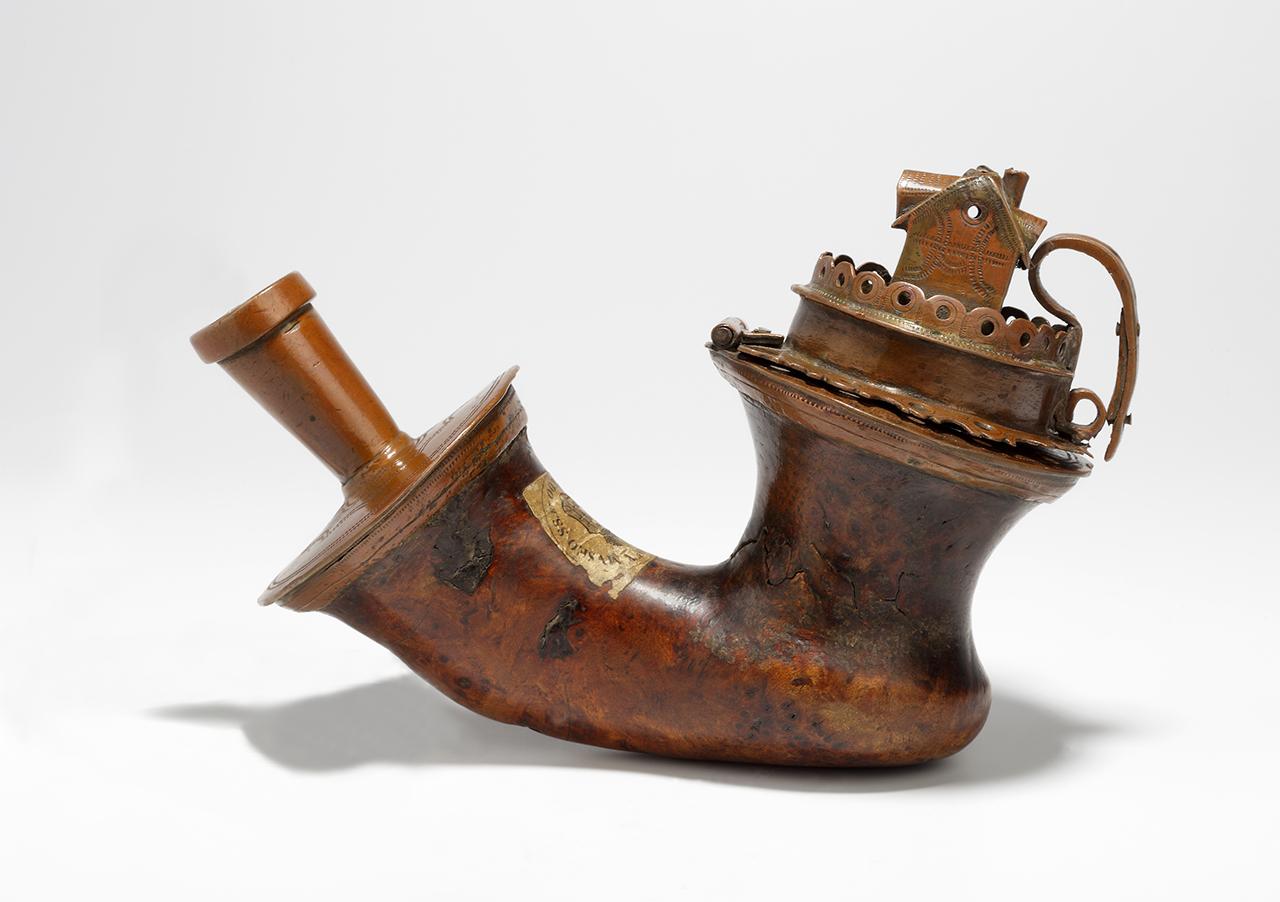
The earliest objects in the Hungarian National Museum, founded in 1802, were donated to the collection. The first pipe, a unique piece carved from a root and fitted with a cottage-shaped copper cap, was donated to the museum in 1813 by András Szabadhegyi, a judge in Komárom County. According to oral tradition, the Turkish bey of Neszmély smoked it, but this is quite unlikely.
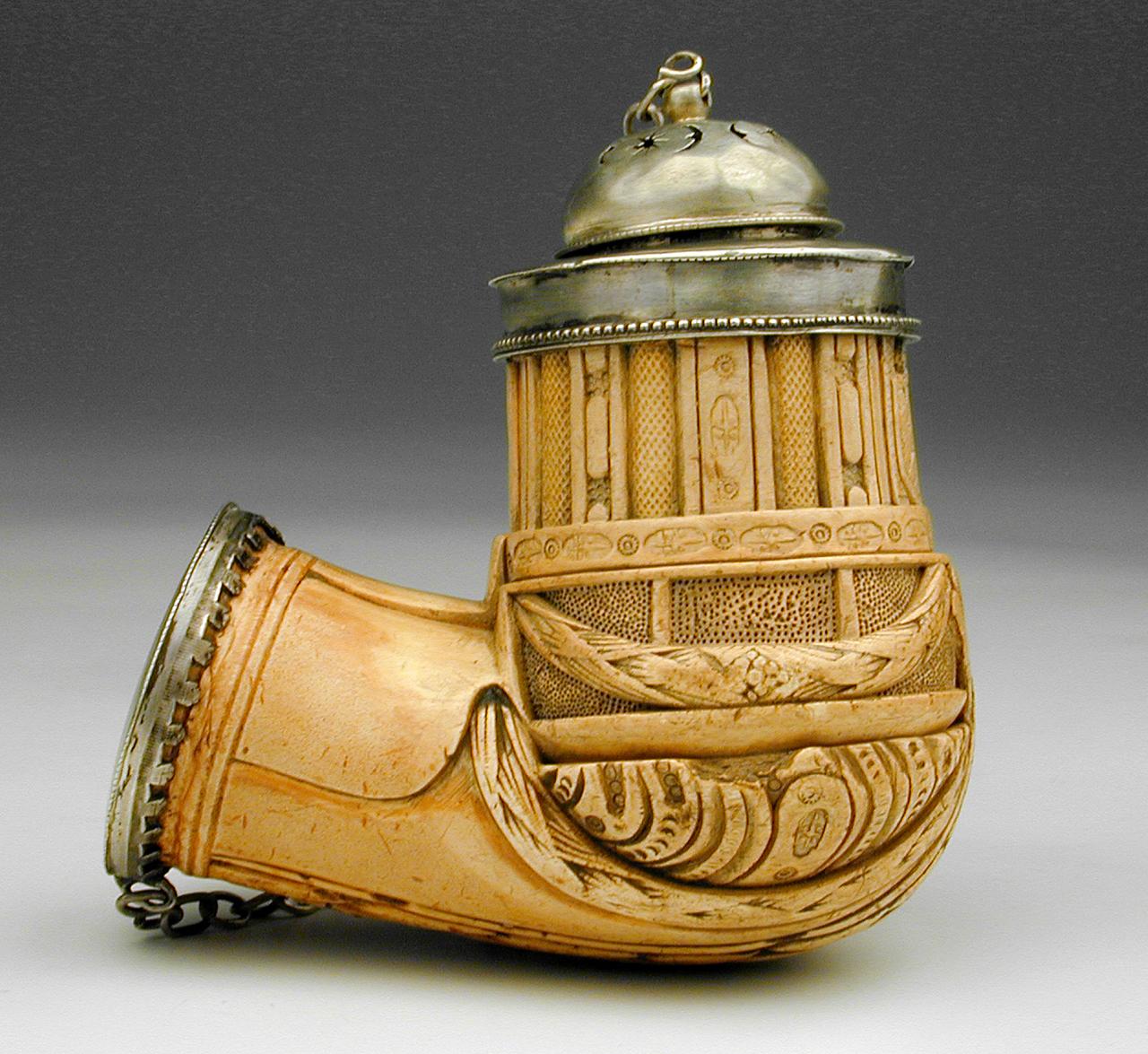
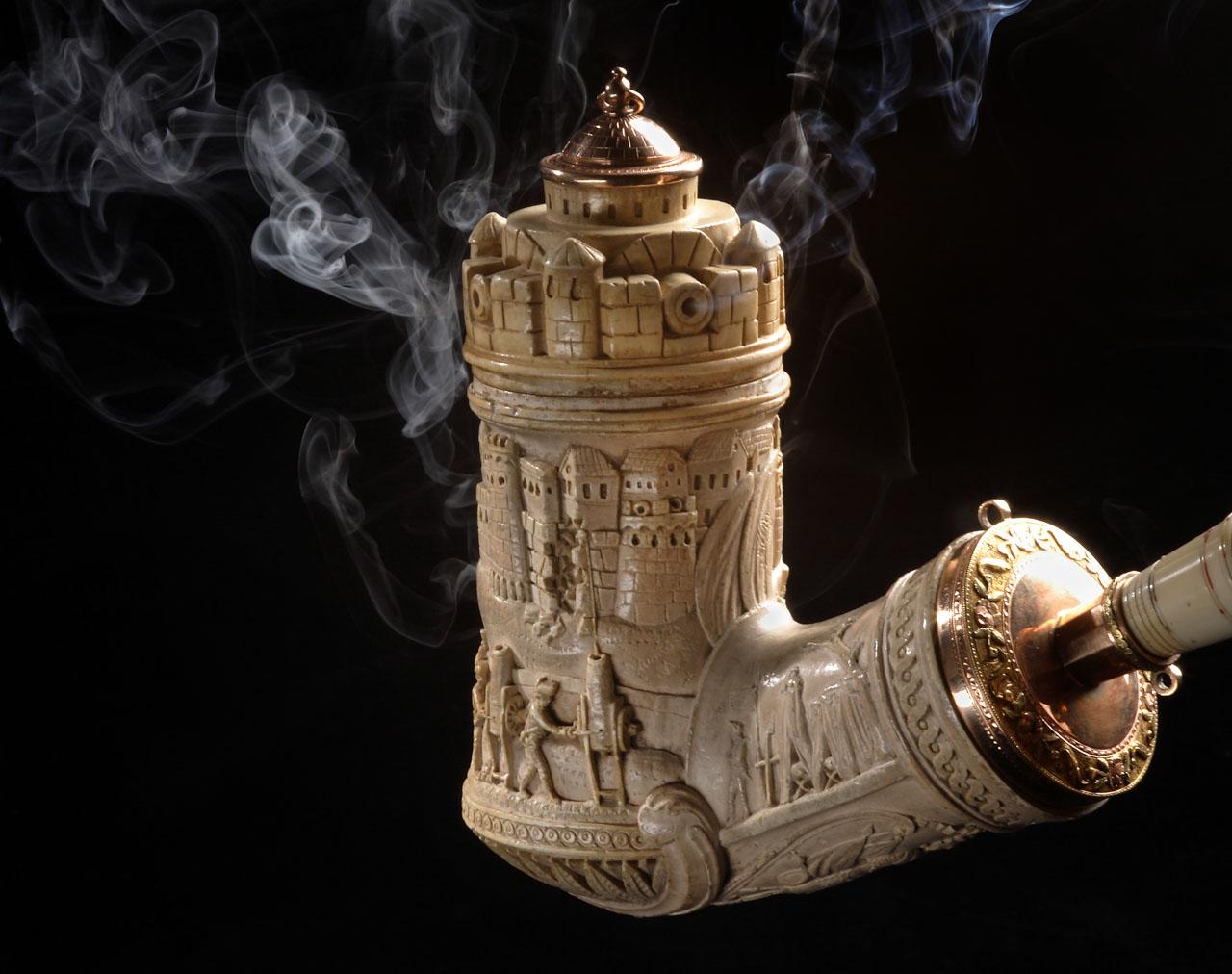
Countess Istvánné Szapáry, née Konstancia Aczél, donated the collection's only gold-mounted pipe of exceptional beauty, together with its ornately crafted ivory stem, to the Hungarian National Museum in 1933. The former owner may have been Count Vince Szapáry (1768–1851), imperial and royal chamberlain and privy councilor. Carved into the snow-white meerschaum, a richly detailed miniature battle scene can be seen. With a technically brilliant solution, smoke would have billowed from the besieging cannons during use through channels leading into the wall of the pipe bowl. However, the pipe was never smoked, but kept as an ornament.
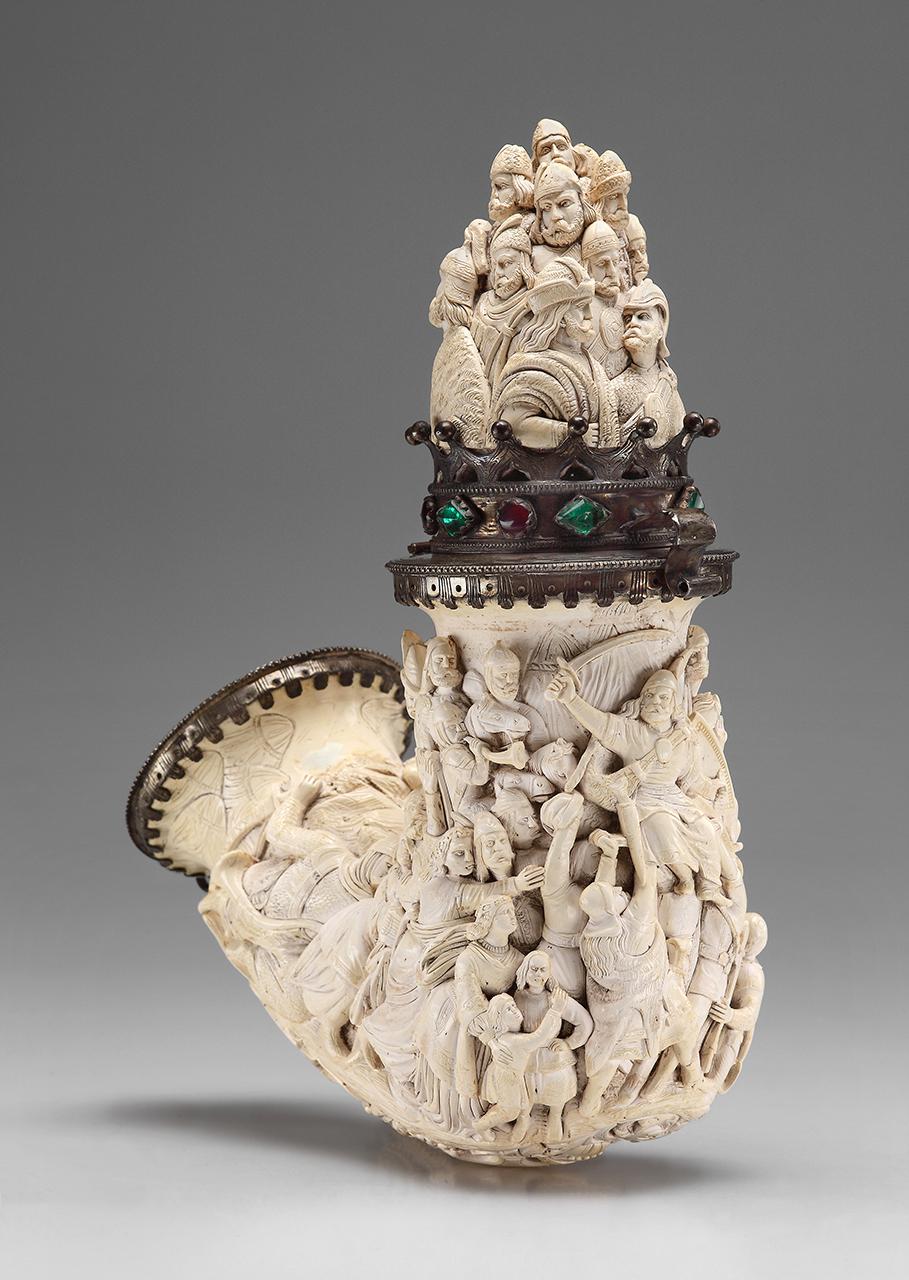
The rich carving on the pipe stem depicts Árpád being raising on a shield. The master craftsman expressed the historical rights of the Hungarian nobility and their role in electing rulers to his contemporaries in the 1850s and 1860s. The composition faithfully follows Mihály Kovács's painting on a similar theme, which became popular in lithographic form (1854), within the limits of the sculptural possibilities available. At the bottom of the pipe is the Hungarian coat of arms with the crown. Below it, among military insignia, is another coat of arms in a shield, probably referring to Prince Árpád: a bird (turul) with spread wings holding an arrow between its claws. The Hungarian national colours appear on the cap, with red and green glass stones alternating on the open, beaded silver crown that surrounds the conical meerschaum section. On the mouthpiece cap, the master engraver highlighted a characteristic half-figure from the scene, representing national unity, each with a different social status. Next to the stem hole, the inscription HONFI appears in the meerschaum. The year 1863 is inscribed below the rim. The beautifully carved, valuable pipe was a man's pride and joy, as well as an expression of his national consciousness and political opinion, and its fire chamber bears indicates frequent use.
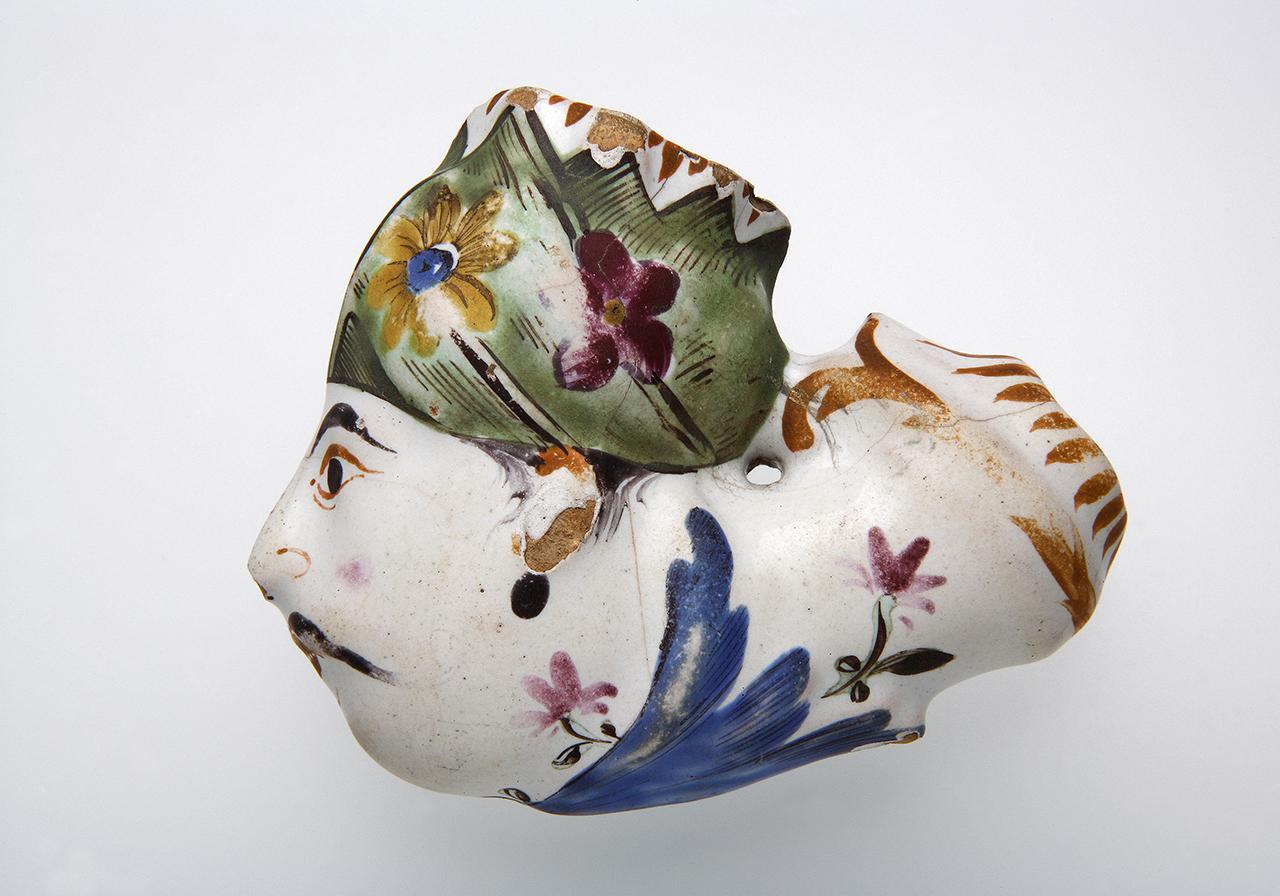
The tin-glazed faience pipe depicts a finely modeled, mustachioed Turkish man's head painted in vivid colors. His green turban is decorated with colourful flowers, and he wears dark earrings. Around his neck is a large blue leaf ornament. This damaged, high-quality piece, found during the dredging of the River Danube, may have come from the faience factory in Holics (now Holič, Slovakia), which was established under the patronage of the Habsburg ruling couple, Maria Theresa and her husband Francis of Lorraine.
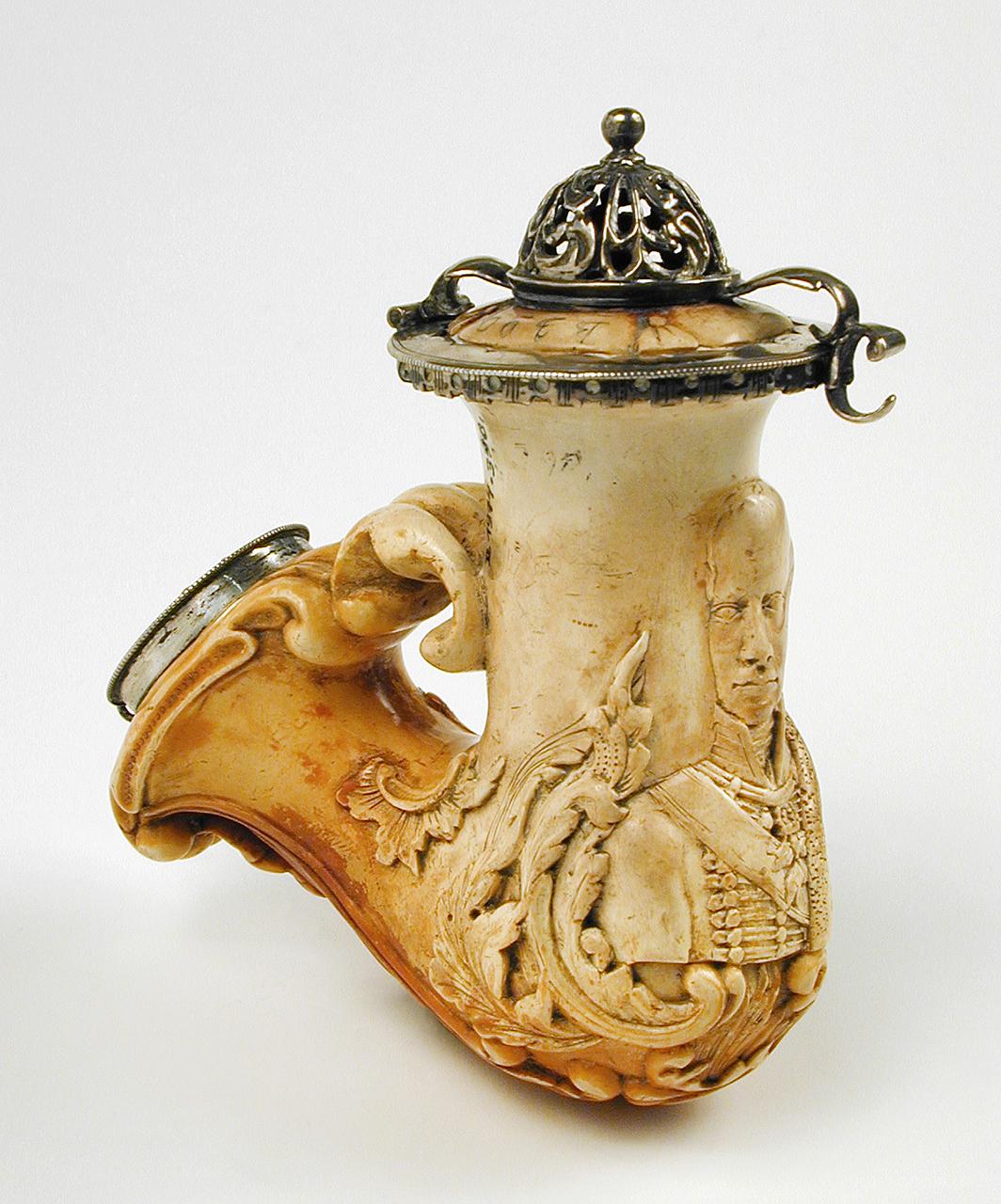
On the front of the flanged bridge pipe, among neo-rococo leaf motifs, there is a finely carved bust of Palatine Joseph. The depiction of portraits of famous historical figures and rulers was a means of expressing respect and representing power. The Habsburg archduke, Palatine of Hungary, is depicted in Hungarian attire. The lamb of the Order of the Golden Fleece can be seen around his neck. The pipe has an elegant convex openwork silver cap. Engraved on the bottom: J. Schweger 1837. This is the work of Joseph Schweger, one of the most significant pipe carvers of the era, whose many masterpieces are known with his master's mark on them.
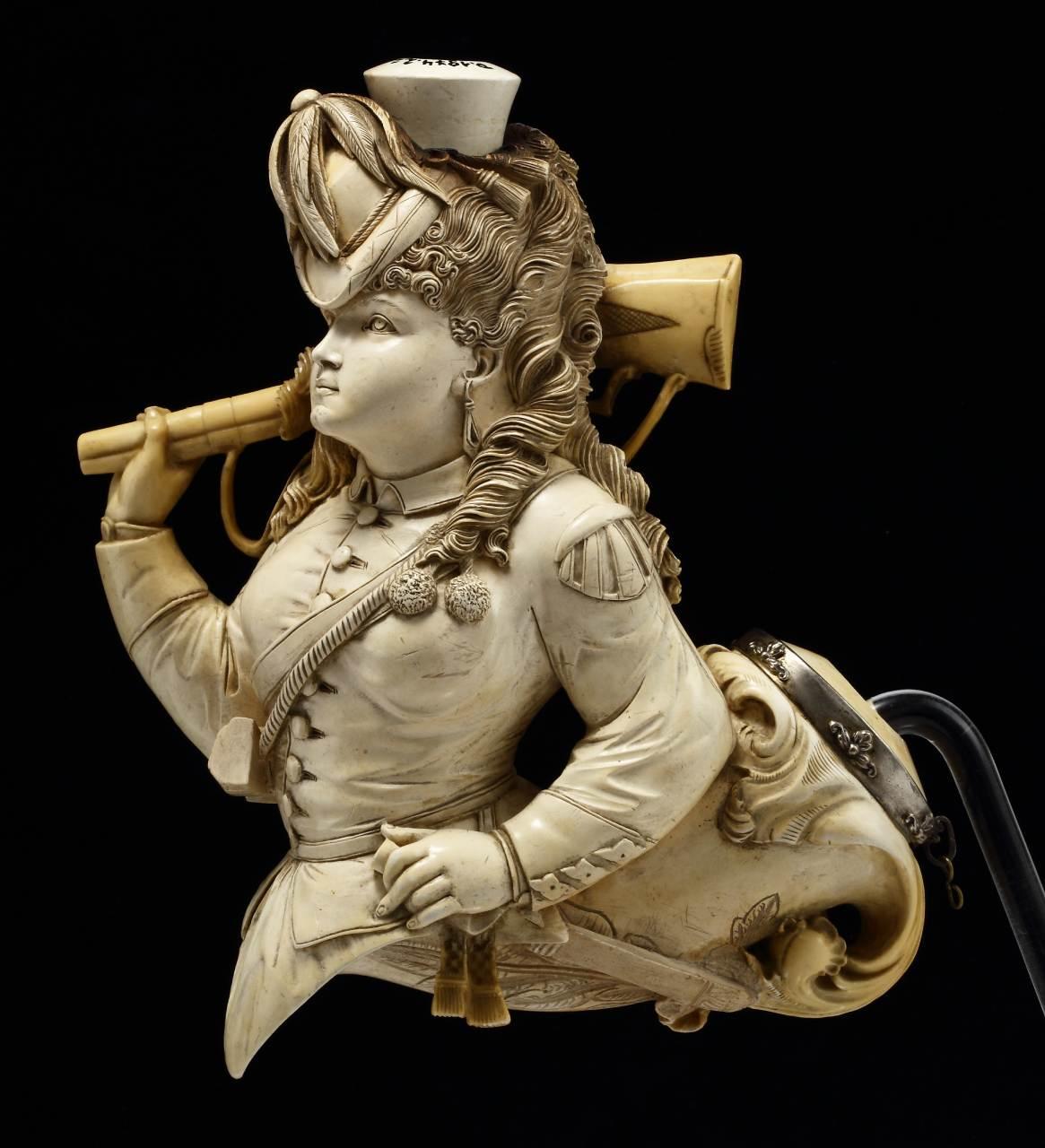
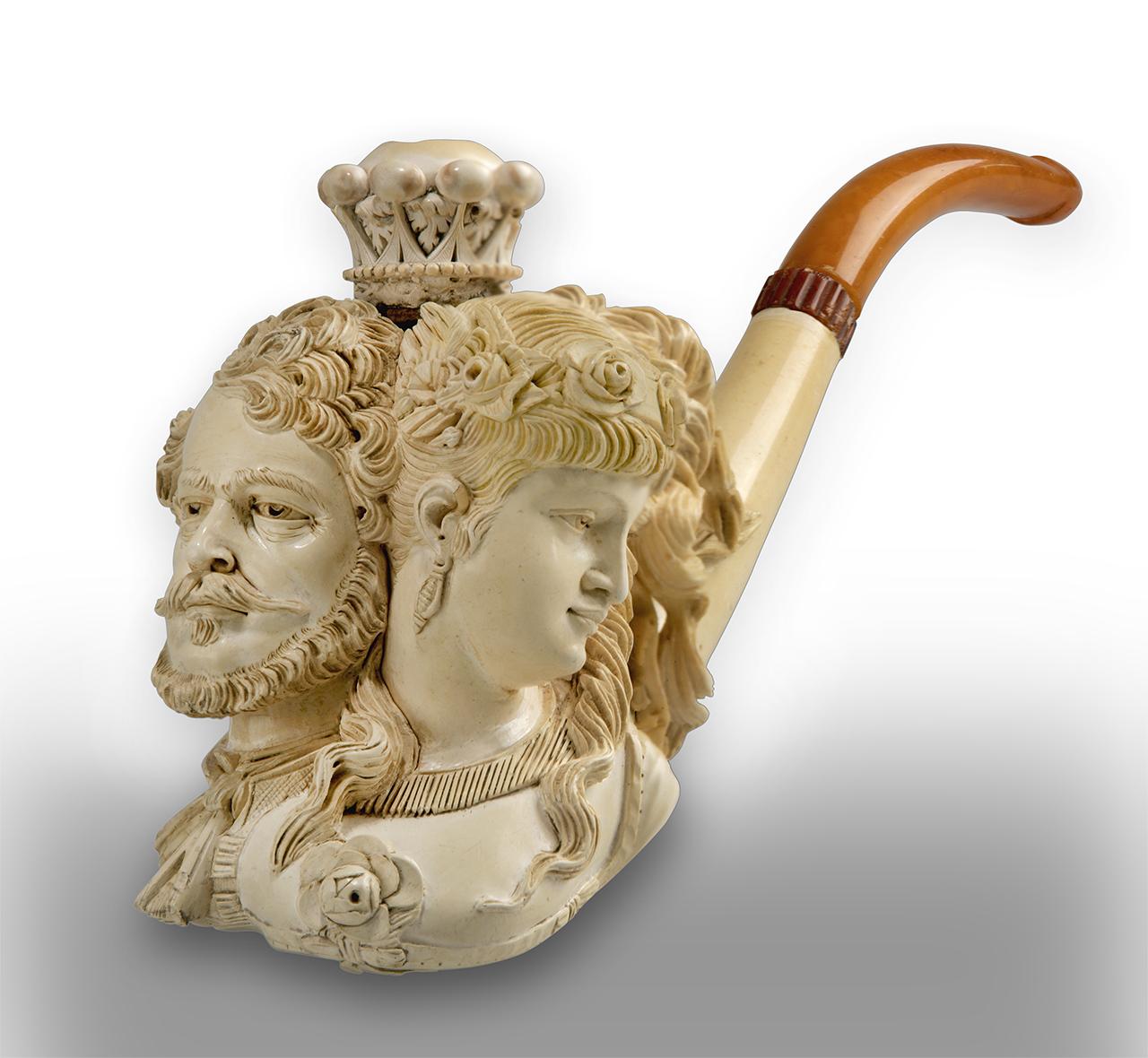
Large cigarette-holder pipe with amber mouthpiece. The pipe bowl features an artistic, three-dimensional carving of a double portrait of Count Gyula Andrássy and a female figure. The features of the beautiful lady are clearly, but not entirely, reminiscent of Queen Elizabeth. She wears a rose-adorned headband above her long, curly hair. The flower-adorned tiara in her hair and the rose at her décolletage may be familiar from a photograph of the Queen from the 1860s. The crown-shaped mouthpiece insert is also indicative of her. However, we do not know any image of her with earrings. (Gyula Andrássy's wife, Countess Kendeffy Katinka, also has a profile photograph with a similar hairstyle. She always wore earrings.) The man looks straight ahead, while the woman gently tilts her head to the side. Above their heads, a beaded crown-shaped insert fits into the mouthpiece of the pipe. Thus it could be (or could have been) smoked in two ways. However, this pipe was never smoked; it served as a representative ornament. Count Gyula Andrássy (1823–1890) was one of the most important Hungarian politicians of the Compromise era, Prime Minister of the Kingdom of Hungary (1867–1871), and Joint Minister of Foreign Affairs of the Austria-Hungary (1871–1879).
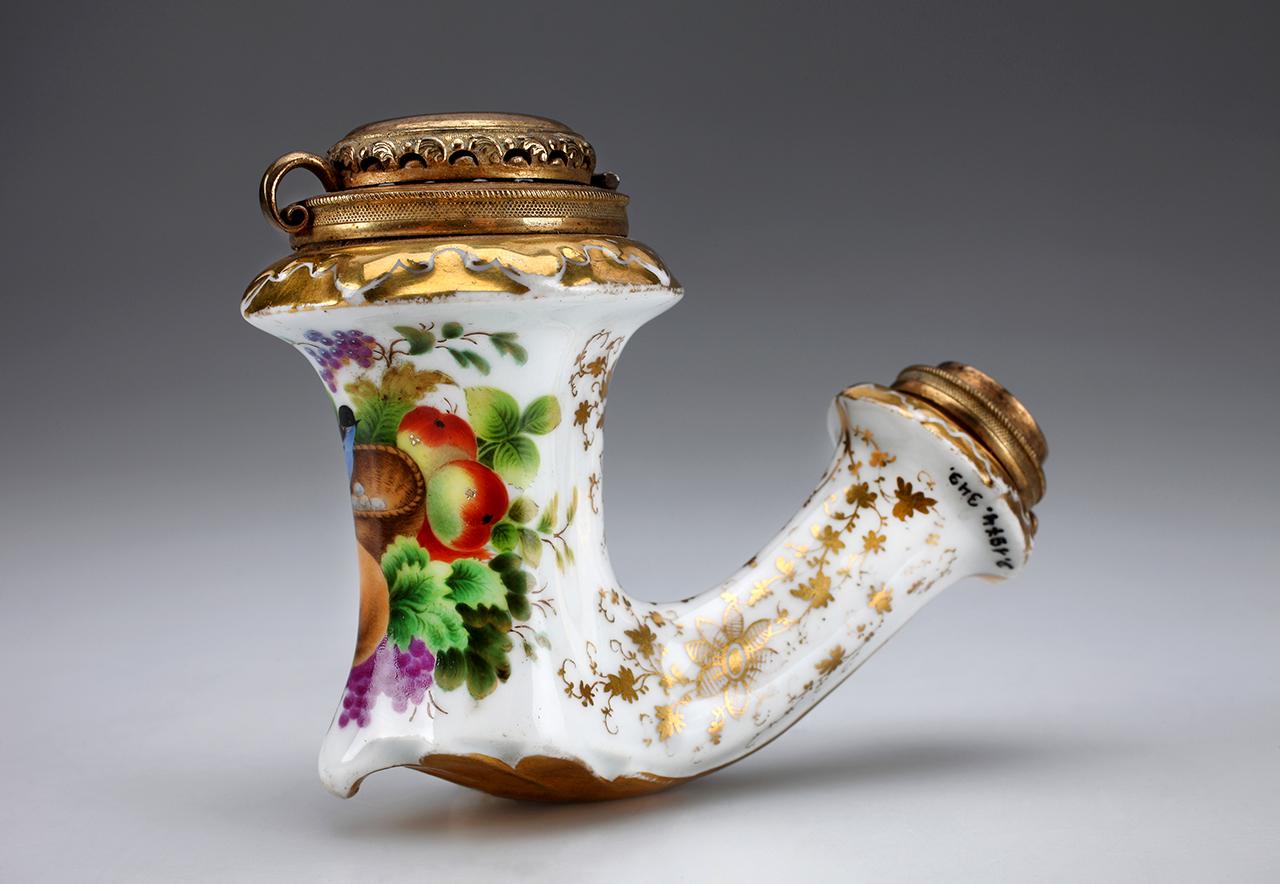
The raw material for porcelain, known as white gold, and the technology used to produce it were long kept secret in China. The first European porcelain factory was established in Meissen, Saxony, near Dresden, in 1710. In the same year, the first porcelain pipe was exhibited at the Easter Fair in Leipzig. The pipe in the National Museum was probably made in Meissen in the early 19th century, as indicated by the two crossed swords visible on the pipe bowl. Its elegant, polygonal shape with flared ends is supported by a gilded acanthus leaf with wavy edges. The front is artistically decorated with a hand-painted miniature fruit still life with a bird. The polygonal neck is decorated with an elegant, light golden flower and leaf garland. The pipe is mounted with gilded copper, and its lid is embossed with a bust of a man in Baroque clothing and a wig.