The Graphic Arts Collection, with nearly 45,000 pieces, is divided into six thematic units. The two largest of these are the group of portraits and the group of views, consisting of some 19,000 and 7,000 sheets respectively, arranged in alphabetical order. The third large unit is a collection of 3 600 costume pictures, divided into a series of military uniforms, folk costumes and 19th century fashion pictures. The chronologically arranged series of some 2,500 event depictions is an outstanding source of images of Hungarian history from the 16th to the 19th centuries. The political caricatures form a separate unit, while other subjects not included in the above groups belong to the miscellaneous collection comprising allegories, coats of arms, family trees, triumphal arches, theses, sacred images, maps and plans.
Contact Dr. Szabolcs Serfőző, serfozo.szabolcs@mnm.hu Tel.
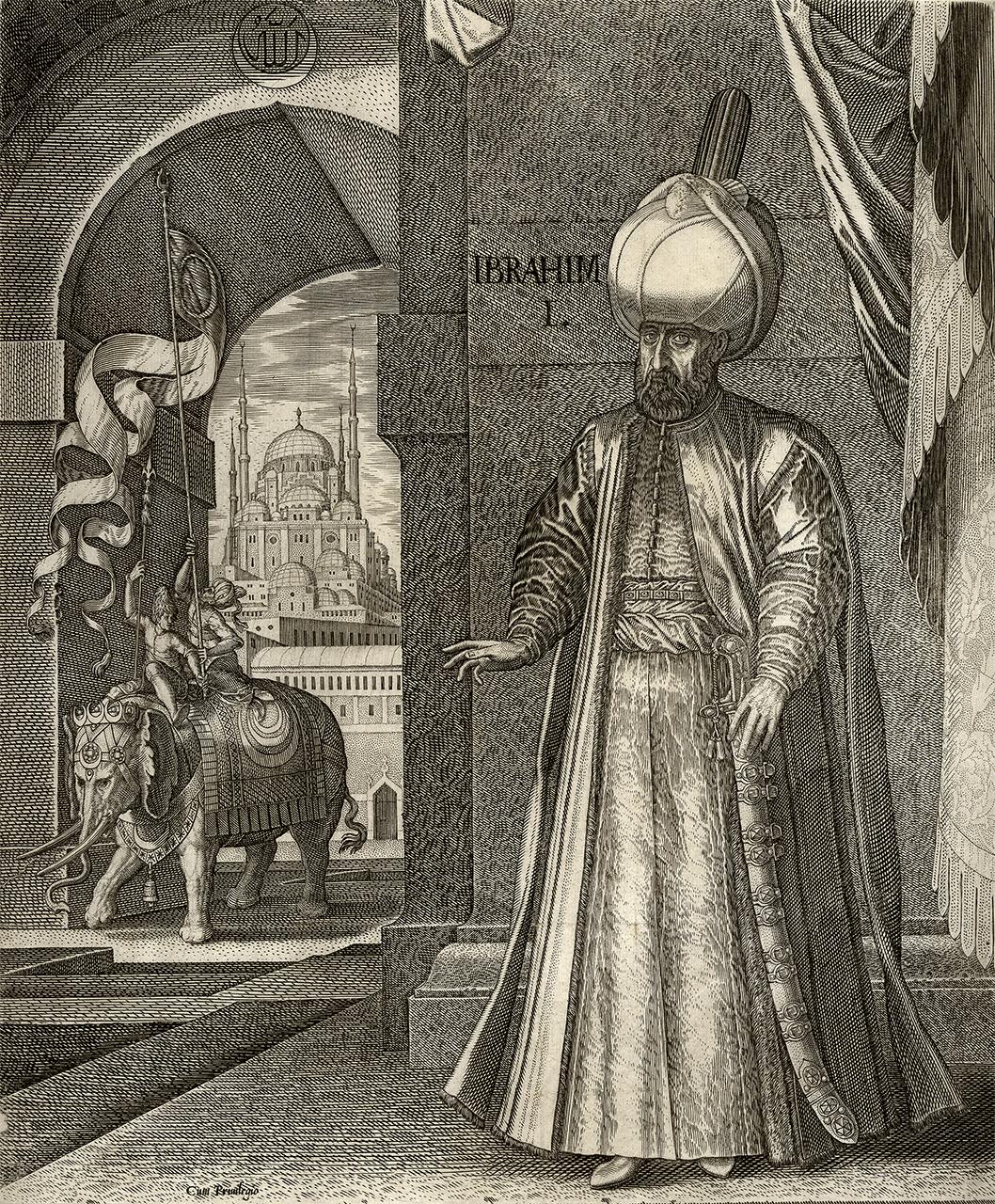
Melchior Lorch (1525/26 – after 1583), paper, etching; later inscription in the centre of the picture: 'IBRAHIM / I.'
Melchior Lorch, a Danish-born member of the embassy to Constantinople led by Augier Ghislain de Busbecque, a Belgian diplomat, which visited the Turkish port on behalf of Ferdinand I between 1556 and 1559. Lorch made a number of sketches, including views, portraits and genre pieces, and after his return home he relied on them preparing his copperplate and woodcuts, which he published in various volumes. The picture shows the Sultan standing in front of the gates of Constantinople, through which an ornately decorated elephant is passing, with two Turks on its back, holding the insignia of the Ottoman Empire, a crescent flag and ponytail bonces. The new mosque, the Süleymaniye, built by Süleyman, can be seen in the doorway. The elderly ruler appears in traditional Turkish clothes, wearing a fur-trimmed open cloak with a silk caftan underneath, a huge turban on his head and a jewelled sabre at his side. According to the inscription on the first version of the portrait of Sultan Süleyman, Lorch made the preparatory sketch in Constantinople in 1559, but the engraving was not made until 1574, when his work Soldan Soleyman Turkischen Khaysers was published in Antwerp.
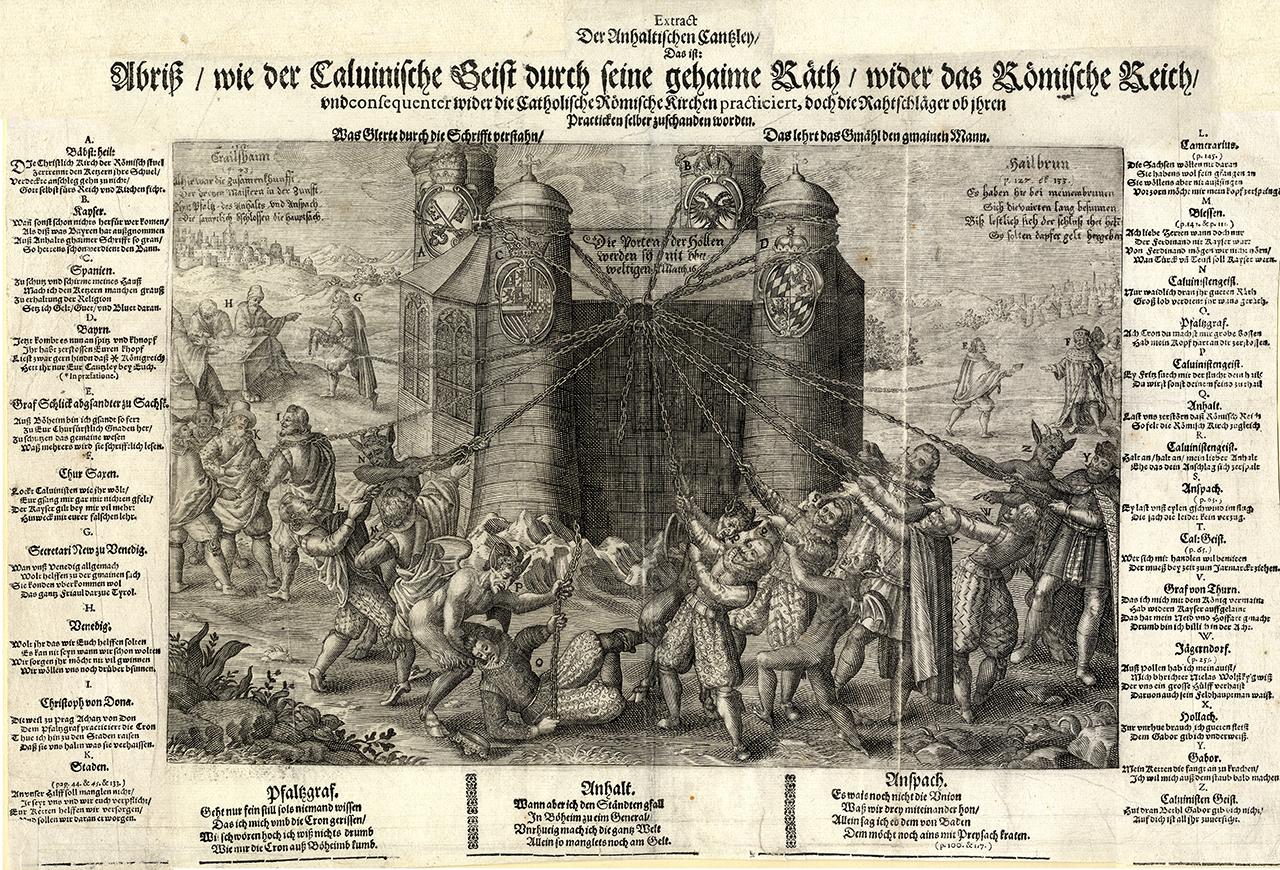
Pamphlet on the Protestant Union unsuccessfully besieging the stronghold of Catholicism, unknown master, 1622, paper, etching
The illustration on the pamphlet shows the Protestant princes (Count Schlickt, I. King John George of Saxony, Karl Hannibal Burggrave von Dohna, Frederick Electoral Prince of Pfalz, Christian Duke of Anhalt-Bernburg, Baron Matthias von Thurn and Gábor Bethlen) unsuccessfully trying to destroy the anti-Habsbrur castle of Catholicism with chains, encouraged by the spirit of Calvin in the form of the devil.
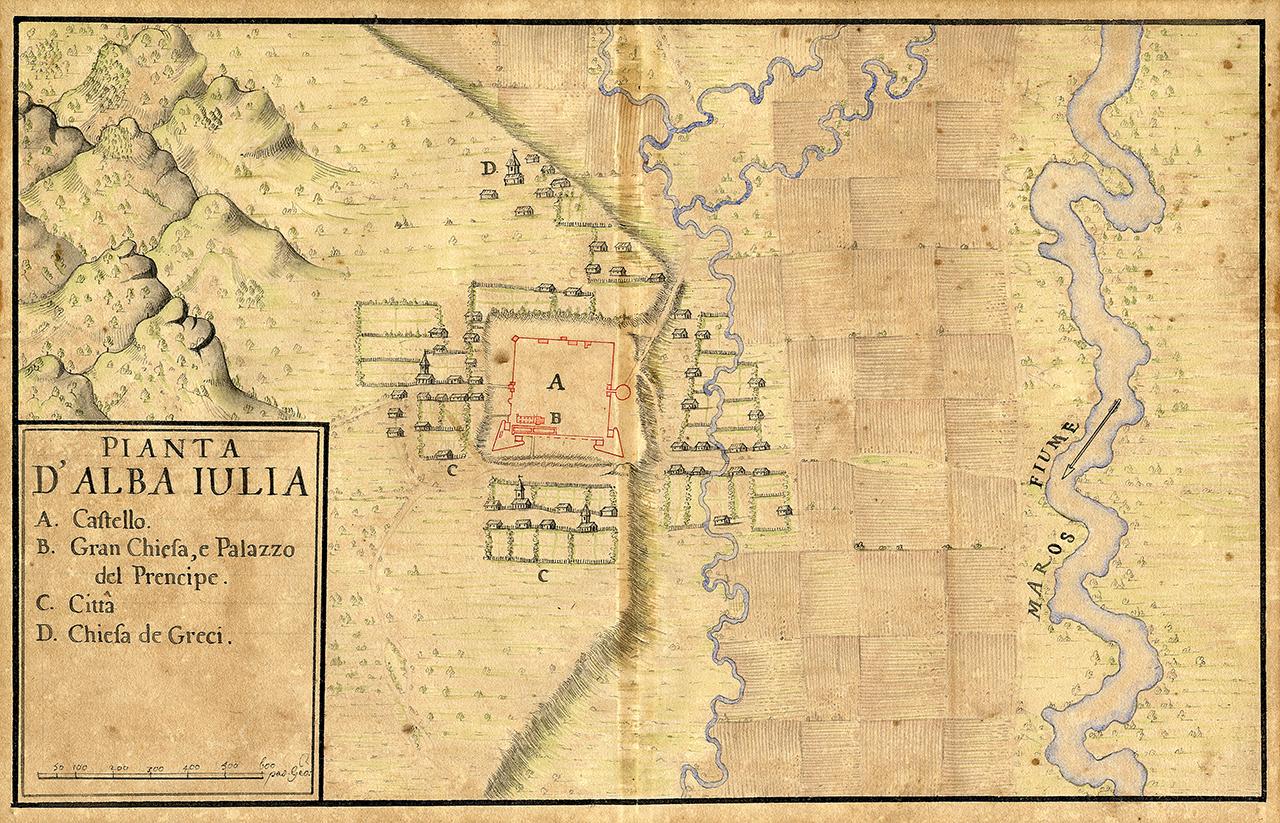
Luigi Ferdinando Marsigli (1658–1730), paper, ink, watercolour
This is part of a series of eleven maps of the places where Archduke Charles of Lotharingia marched his army to Transylvania in the autumn of 1687, and after the liberation manoeuvres he concluded the Treaty of Balázsfalva with Prince Mihály Apafi I. The maps show the layout of the towns and fortifications from a military point of view, concentrating mainly on the fortifications, while the town districts and the surrounding areas are somewhat sketchy. The layout of the castle bastions, the cathedral and the prince's palace in Gyulafehérvár is true to reality, while inaccuracies in the details, such as the two inner courtyards instead of three and the straight-ended sanctuary of the cathedral, suggest that the drawing was not entirely based on a field survey. The Italian military engineer and cartographer Marsigli took part in the campaign as an officer of Charles of Lotharingia, and personally negotiated the transfer of Szilágysomlyó, so knowing his interest in cartography, it is very likely that he himself completed the drawings.
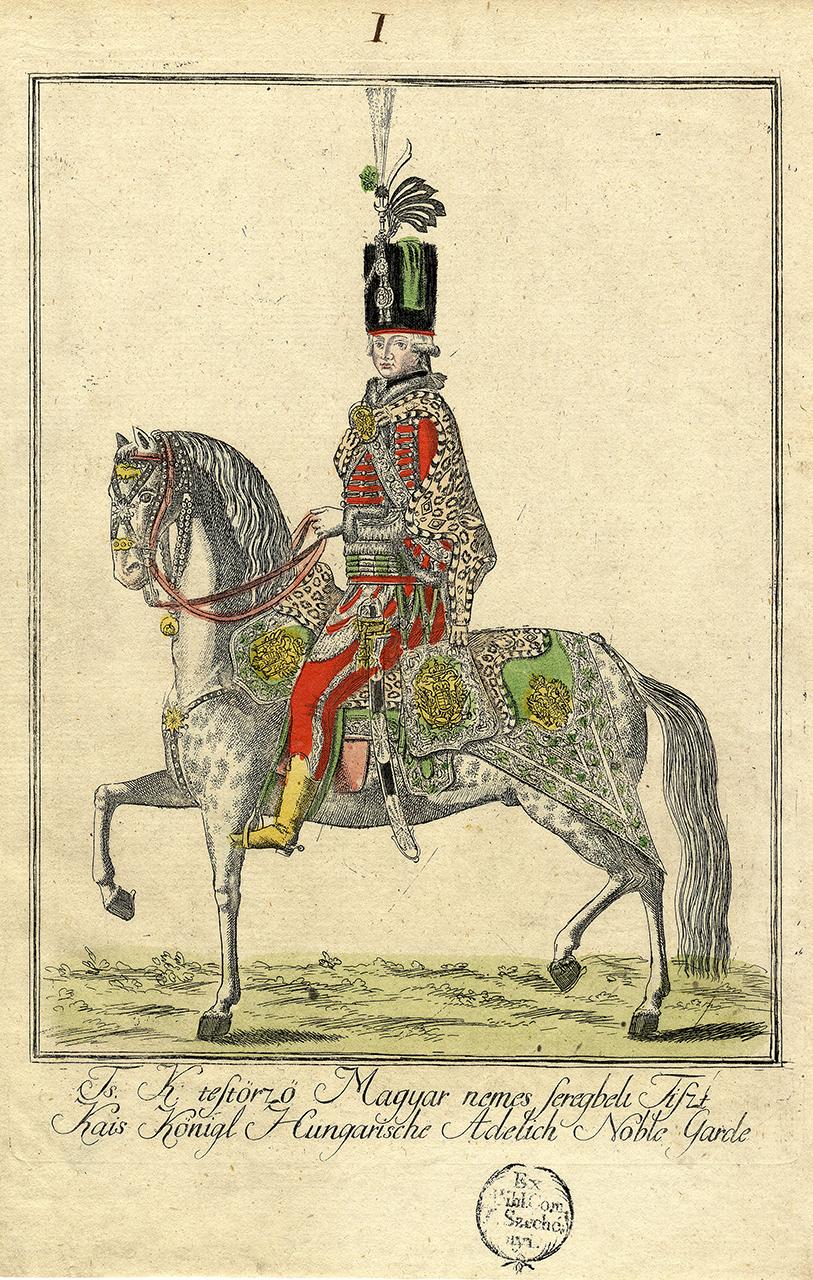
G. Adamscheck, coloured copper engraving on paper
Queen Maria Theresa established the Hungarian Royal Guard in 1760 out of gratitude for the valiant Hungarian soldiers who had participated in the wars of succession. The royal guard of 120 members was staffed and financed by the counties, giving young members of the nobility the opportunity to serve and rise in the Viennese court. Between 1760 and 1849, more than 1,200 Hungarian noblemen served an average of five years in the guard, where, in addition to military training, they took classes in languages (French, German, Italian), Hungarian law, dancing and manners. They lived in one of the most beautiful baroque palaces in Vienna, bought from the Counts of Trautson and built by Johann Bernhard Fischer von Erlach. Despite the fact that the corps also served the Germanisation policy, especially during the reign of Joseph II, it was from here that the Hungarian pioneers of Hungarian literature and language education emerged. The guard's red hussar uniform with silver tassel, panther skin cape and fur cap, was the most elegant Hungarian military uniform until the dissolution of the guard in 1918. Their depictions were popular in Viennese art circles, and interest in them grew especially around the coronations of kings, as this reproduction of a print for the general public from the coronation of Leopold II (1790) or Franz I (1792) shows.
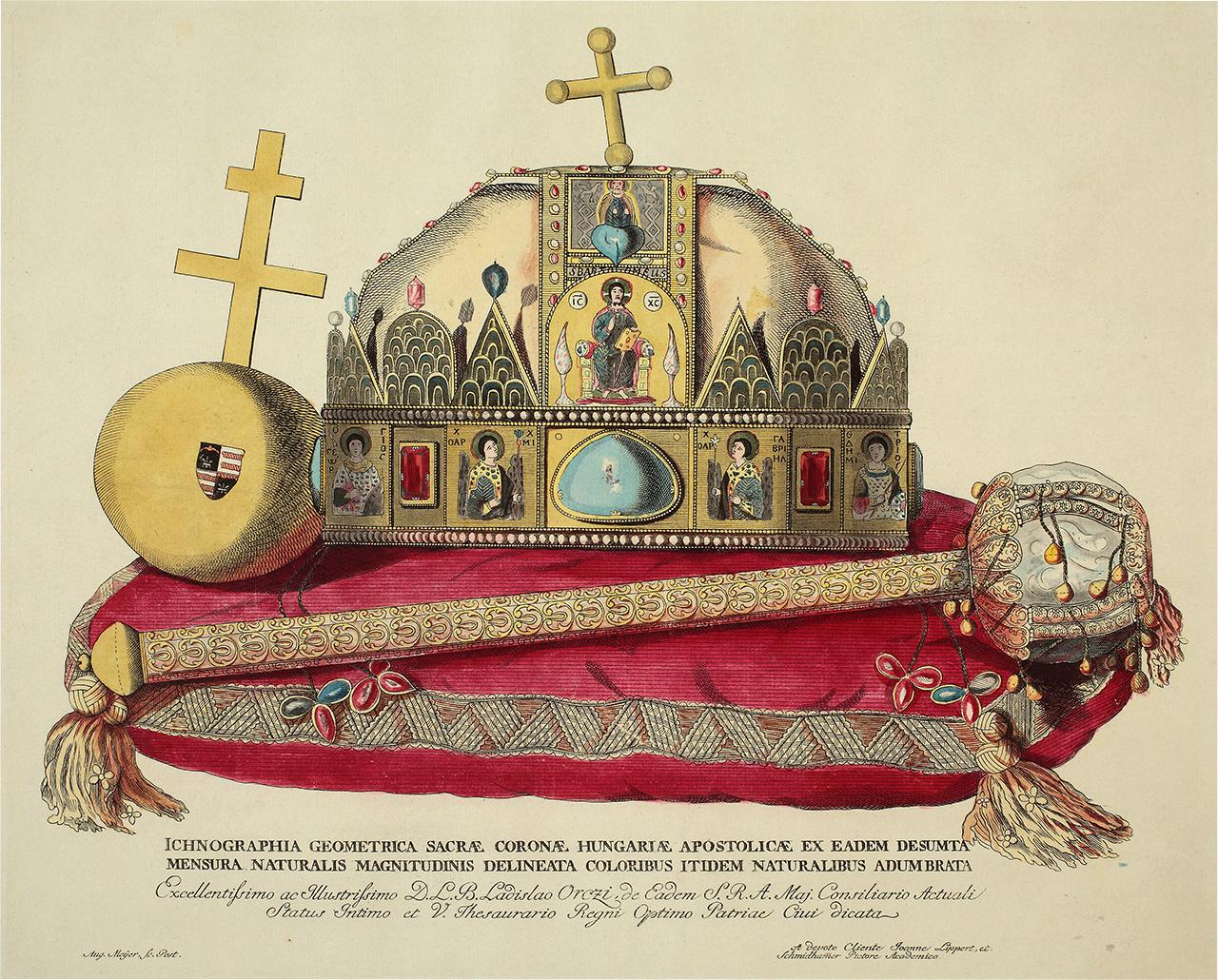
August Meyer (active 1784–1820) after a drawing by Ferenc Schmidhammer (?–1796), coloured engraving on paper
This engraving, made in Pest, is a witness of the growing national and scientific interest in the Hungarian crown in the 1790s. Joseph II ("King with the hat"), who did not have himself crowned, took the coronation insignia to his treasury in Vienna, and they were not returned to Buda until 1790. The Hungarian nobility celebrated their ancestral rights and freedom against Germanizing absolutism in the returning crown. Shortly before this engraving, the first authentic engraving of the crown was made in Vienna, and not long afterwards, in 1792, the first monograph on royal insignia and coronations, illustrated with engravings, was published by Sámuel Decsy Baranyai. The engraving, which depicts the Holy Crown, the sceptre and the orb on a red velvet cushion, was made by artists from Pest-Buda in honour of the returning crown and dedicated to László Orczy, the leader of the crown guards.
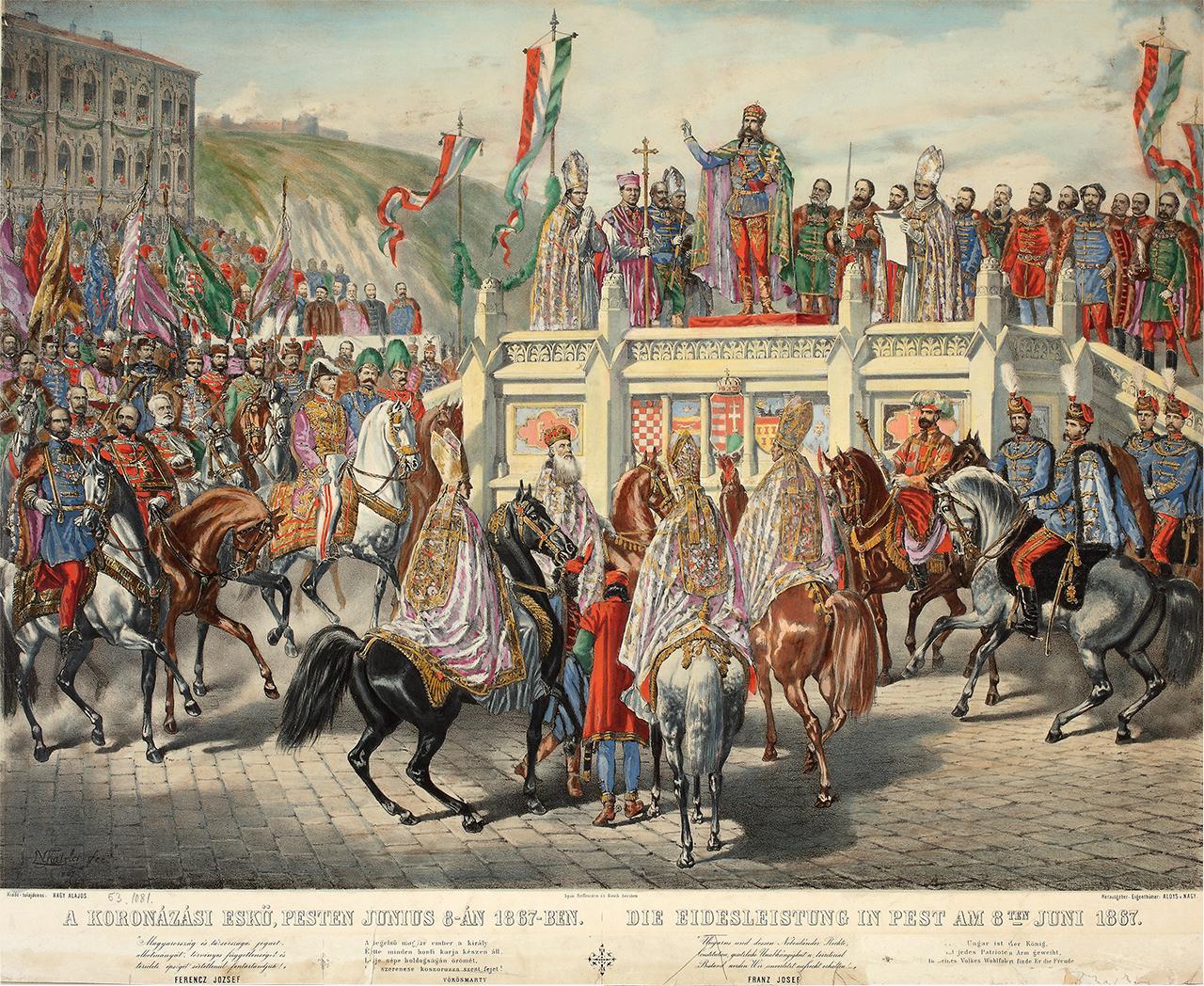
Vinzenz Katzler (1823–1882), coloured lithograph on paper
The coronation of Franz Joseph, who had crushed the Hungarian War of Independence and ruled absolutistically without being crowned from 1849, was made possible by the Austro-Hungarian Compromise of 1867. The coronation ceremony was held in the Matthias Church in Buda Castle (later the Coronation Church), after which the procession marched to the garrison church for the inauguration of the gold-spurred soldiers. From there they rode on horseback across the Chain Bridge to the platform on the Pest quay, where, according to the contemporary description, "His Majesty stood alone in the middle of the three steps covered in golden drapery, after handing the oath-form presented by the Prime Minister Count Andrássy to the Archbishop. The Archbishop now reads the oath aloud. His Majesty, facing East, holding up three fingers of his right hand and the crucifix in his left hand, takes the oath. After the oath has been taken, Prime Minister Count Andrássy calls three cheers upon the Lord and King, which is repeated by the people." After another military volley, they marched on to the present-day Széchenyi István Square at the Pest bridgehead of the Chain Bridge, where the king, on a mound erected of the soil of all the Hungarian counties, struck his sword to the four directions, and declared that he would defend Hungary against any external attack. The coronation was concluded with a coronation feast in the Buda Castle Palace.
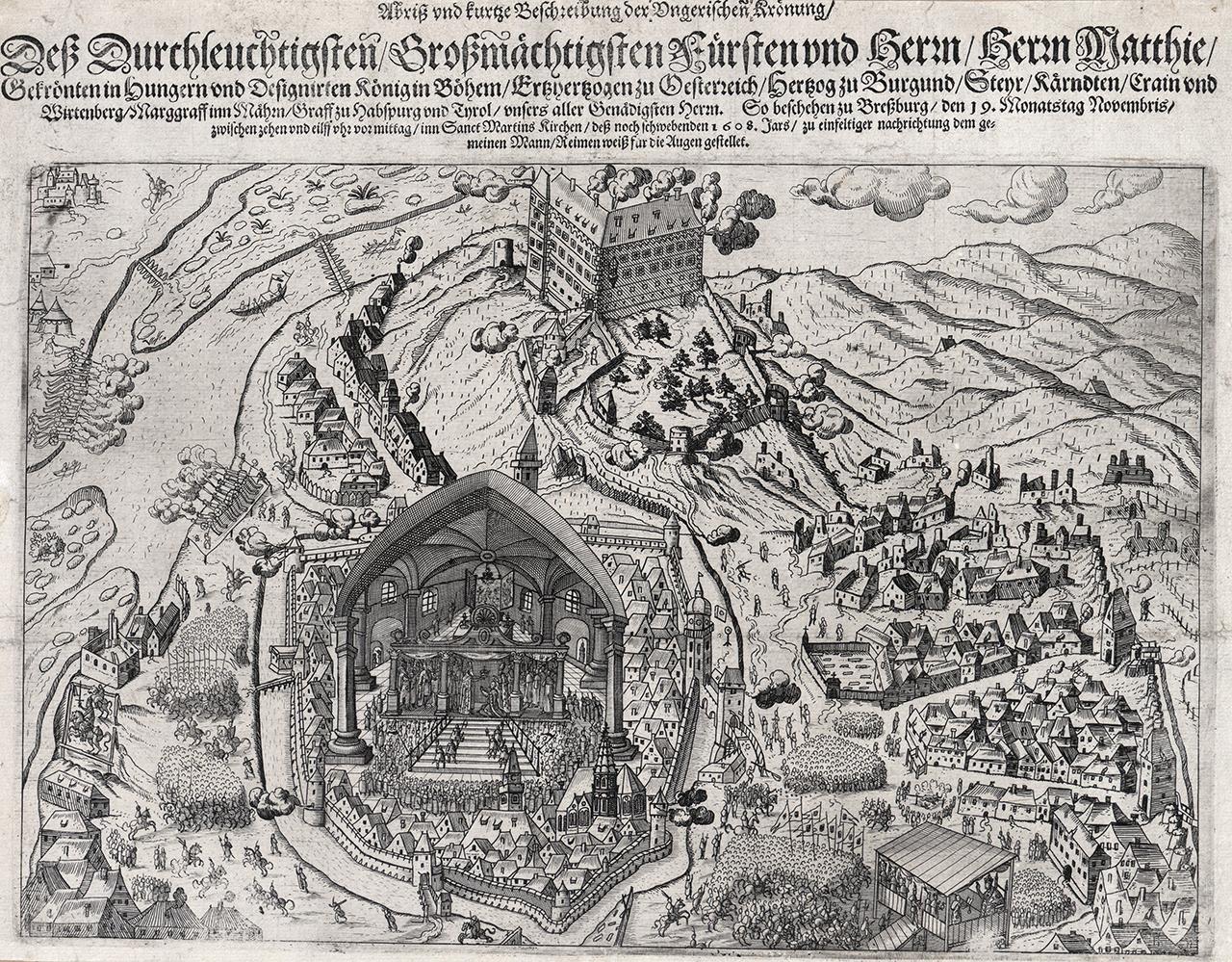
Unknown master, etching on paper
The etching of the coronation of Matthias II in Bratislava shows the city and the castle from a bird's-eye view. At the same time, a sectional view of the Church of St. Martin, placed in the centre of the city, is shown from the west. In the interior of the church, 3 alabardiers stand on the steps of the canopied dais surrounded by people. In the centre, the king kneels between two bishops at the coronation. On either side are the dignitaries of the country. The high altar of the church can be seen in the sanctuary behind the dais. The Franciscan church, where the crowning ceremony was followed by the investiture of the gold-spurred knights, and the towered town hall can be identified within the city. The ceremony then included a procession to the king's mound, built from earth on the banks of the Danube, where the king slashed his sword from his horse's back towards the four cardinal points. In this symbolic act, he declared that he would defend the country from enemies attacking from any direction. This scene is shown in the lower left corner. Cannons are visible on the banks of the Danube and in the castle. Only the eastern and southern wings of the castle are visible without towers, the south-western corner being the only one highlighted with a rhizalite. On another version of the engraving, a verse in German in three columns below the image, at the end of which Johann Holzmüller wishes the king a heavenly crown ("Johann Holzmüller wünscht"), therefore it is attributed to Holzmüller by Závadová, but this is not confirmed by other data. The same inscription is printed under the picture on another engraving of the coronation of Matthias II, also attributed to Holzmüller. The depiction is unique among Bratislava vedutas, as there is no surviving tradition of the eastern bird's-eye view in the 17th and 18th centuries. Another interesting feature of the picture, convincingly presented by Gábor Endrődi, is that it is the only somewhat authentic representation of the late medieval high altar of St. Martin's Church before Donner. The group of very small, schematic figures in the central field of the winged altarpiece more or less corresponds to the arrangement of the so-called "Bethlehem of Galgóc" (Bratislava, Slovenská národná galeria) depicting the Nativity of Jesus, which is now considered by researchers to be the surviving part of the old Bratislava high altar.
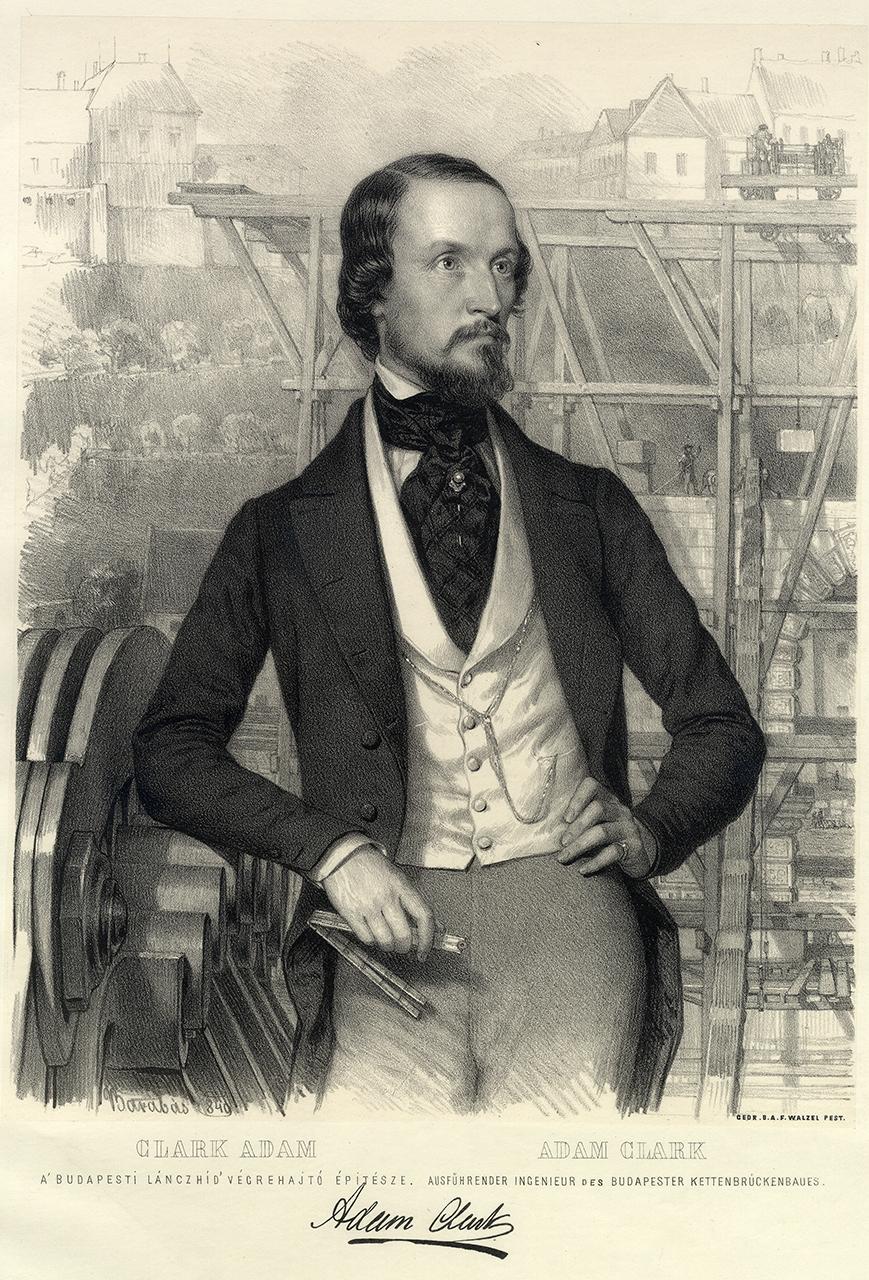
Miklós Barabás (1810–1898), paper, lithograph
Miklós Barabás came into early contact with Adam Clark (1811–1866), the Scottish-born engineer who supervised the construction of the Chain Bridge.He first arrived in Hungary in 1834 to assemble and operate the English dredger called Vidra for Széchenyi's river regulation project. The Count quickly took notice of the ambitious young engineer and asked his opinion on a bridge that was to be built: "many people think that the ice will carry it away and that building it is impossible. You have seen a lot, you know the Danube. So watch it during the winter and make your observations, and then tell us what you think." It is no coincidence, then, that in 1839 he was asked to supervise the construction of the bridge, during which he spent ten years in Hungary, and later, married Maria Áldásy, and started a family in Pest. In his diary, Barabás mentions three times in 1842 that he made a watercolour portrait of Clark and painted his sailing boat on the Danube. The lithograph, published by Frigyes Walzel Ágost's print shop, with a matching pendant depicting William Thierney Clark, the engineer who designed the Chain Bridge, was probably published for the official opening of the bridge in November 1849. The forerunner of the portrait was an earlier watercolour by Barabás, now in the collection of the Budapest Historical Museum in the Municipal Gallery. The contrapposto pose of the knee painting depicts Clark at the top of the Pest pier, leaning on the chain saddle next to him, which is already covered by the chain mail. He holds a measuring rod in his hand and is elegantly dressed in English fashion. In the background is the riverbed pier of Buda, with the crane scaffolding for the carved stones and building materials above, the details of which survive in the plans of the time. In front of the arch of the pier, you can already see the first two cast iron cross beams, attached to the chain by hangers, with only planks still laid across them. Although construction has already been completed at the time of the lithograph, the highly accurate depiction of the technical details shows that Barabás had a thorough knowledge of the construction process of the Chain Bridge.