Founding of the museum
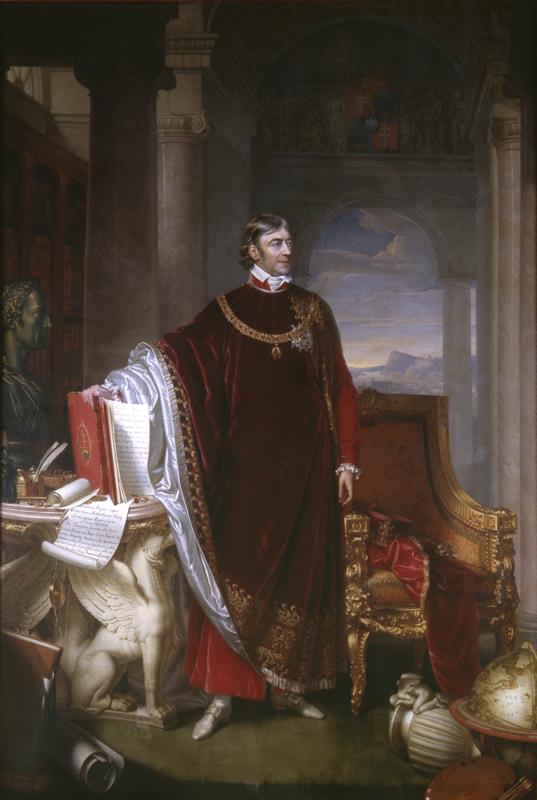
On 25 November 1802, Count Ferenc Széchényi decided to donate his rich collections, declaring that he would “donate, transfer, and assign them irrevocably and forever for the benefit and advancement of my dear homeland and the public.” This generous act was confirmed the following day by royal approval. Although the new institution appeared under various names in the founding documents—National Library, National Museum, Hungarian Museum—according to the concepts of the time, Count Széchényi effectively founded the Hungarian national library. From the very beginning, however, the donation also carried a broader vision, later articulated by Act XXIV of 1807, which expressed gratitude for the noble gesture: The donating count “transferred, with full legal authority, his extensive and carefully selected library, as well as his rare coin collection gathered with exceptional care and expense, the coats of arms of distinguished families, and likewise his maps, paintings, and manuscripts, for the use of the Hungarian nation, thereby laying with praiseworthy zeal the foundations of a national museum yet to be established.”
The first donations
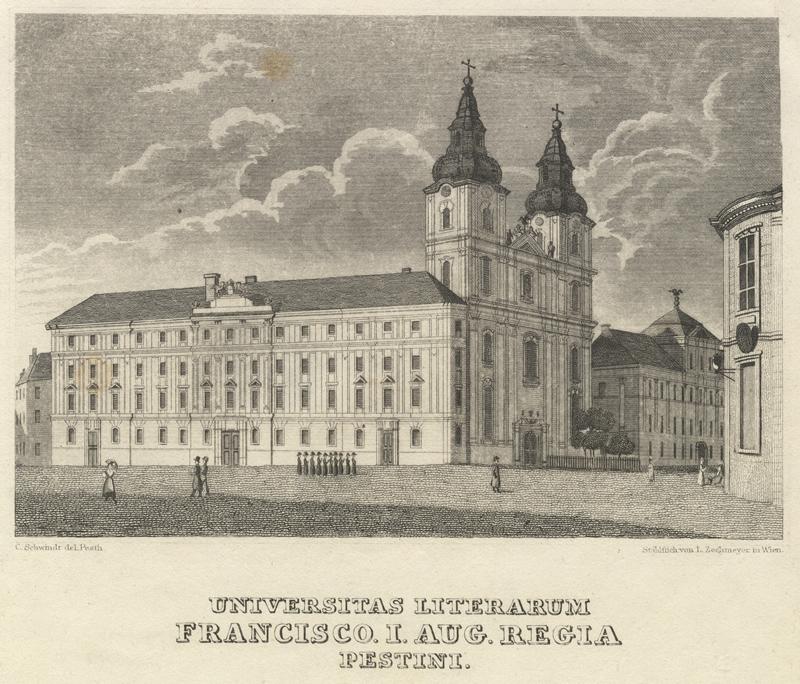
The original donation comprised 11,884 printed volumes, 1,156 manuscripts, 142 bound maps and copper engravings, 2,019 gold coins, as well as coats of arms, other antiquities, and some paintings. These collections were first housed in the library hall of the Pauline monastery in Pest, and from 1807 onward in the former university building situated next to the Pauline (later University) Church.
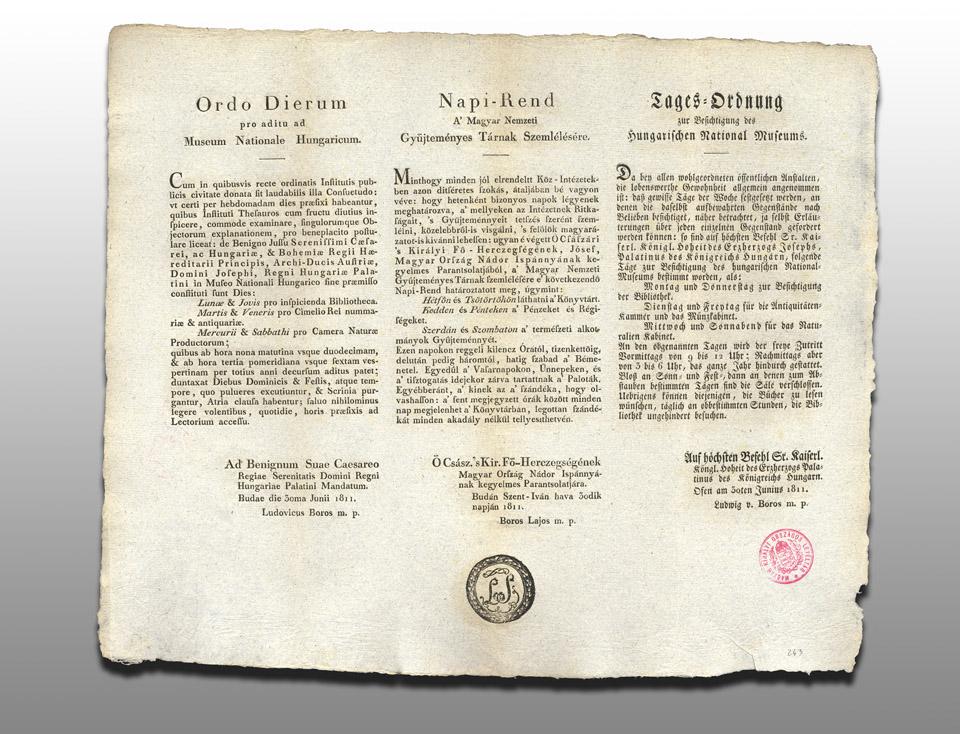
One year later—following several years of preparatory work by the librarian Jakab Ferdinand Miller, and upon the proposal of Archduke Joseph, Palatine of Hungary—the Diet, by Act VIII of 1808, provided for the establishment of the Hungarian National Museum, and for the securing of its financial foundations through contributions pledged by the counties.
Thereafter, the museum collections began to take shape: following the library, a Natural History Collection was established, and subsequently a Collection of Antiquities. In 1812, Jakab Ferdinand Miller was appointed the Museum’s first Director.
In 1813, the state purchased from the Batthyány family the plot of land on which the present museum building stands, and relocated the steadily expanding collections to the urban palace formerly serving as an archiepiscopal residence.
Ferenc Széchényi continued to support the collections; his merits in this regard were later acknowledged by Act XXXV of 1827. The museum was further enriched by a major and defining donation in 1836, when János László Pyrker presented the national collection with his valuable picture gallery, consisting largely of Italian paintings.
Alongside donations, the collections also expanded continuously through acquisitions, including, among others, the rich holdings of the renowned scholar and art collector Miklós Jankovich.
The museum's own building
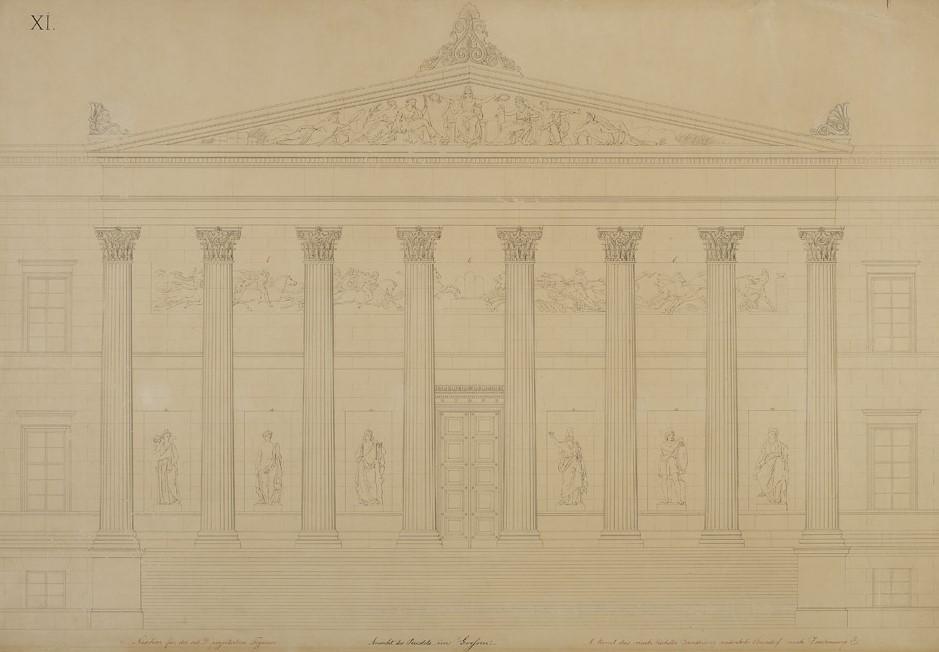
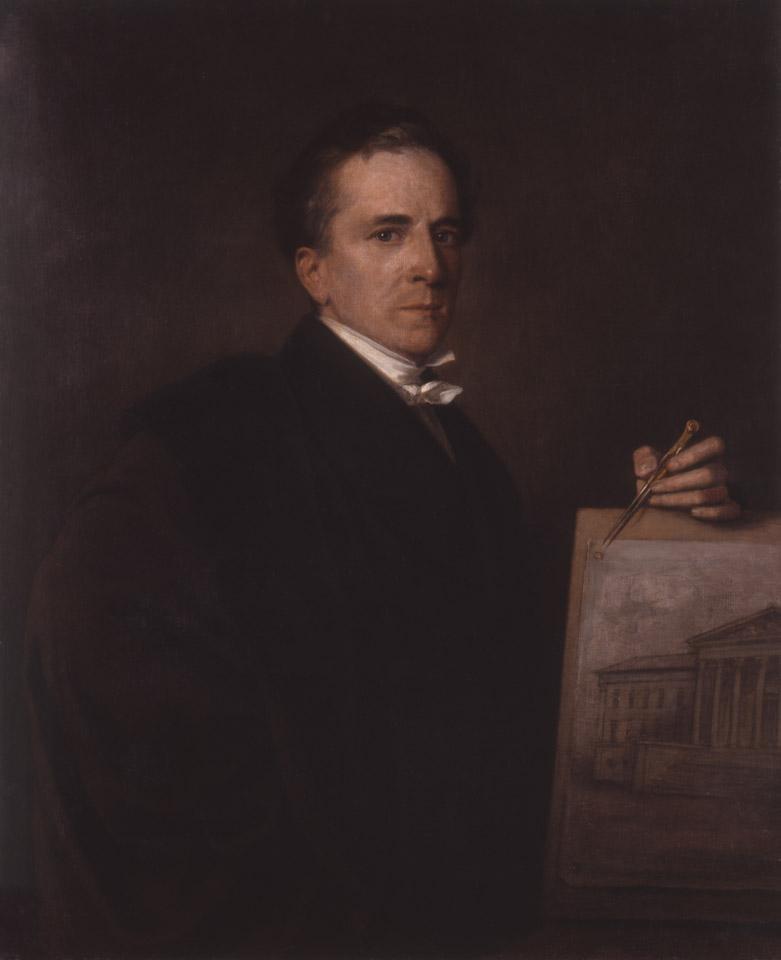
Alongside the growth of the Hungarian National Museum, the construction of a worthy home became a matter of national importance in the first third of the nineteenth century. Ultimately, Act XXXVII of 1836 provided the necessary financial support for the erection of the Museum’s new, purpose-built structure. The design was entrusted to Mihály Pollack, one of the most significant figures of Hungarian Neoclassical architecture. Construction took place between 1837 and 1847. The sculptural decoration of the pediment on the main façade was created by the Munich-based sculptor Rafael Monti. At its centre sits the female figure of Pannonia, enthroned and holding laurel wreaths, which she offers to the allegorical figures of Science and Art on her right, and History and Fame on her left. The figure in the right corner symbolises the River Danube, while the figure in the left corner represents the River Drava. Since 1875, the walls and ceiling of the museum’s grand staircase have been adorned with allegorical and historical frescoes by Károly Lotz and Mór Than.
.
The Revolution and War of Independence of 1848–1849
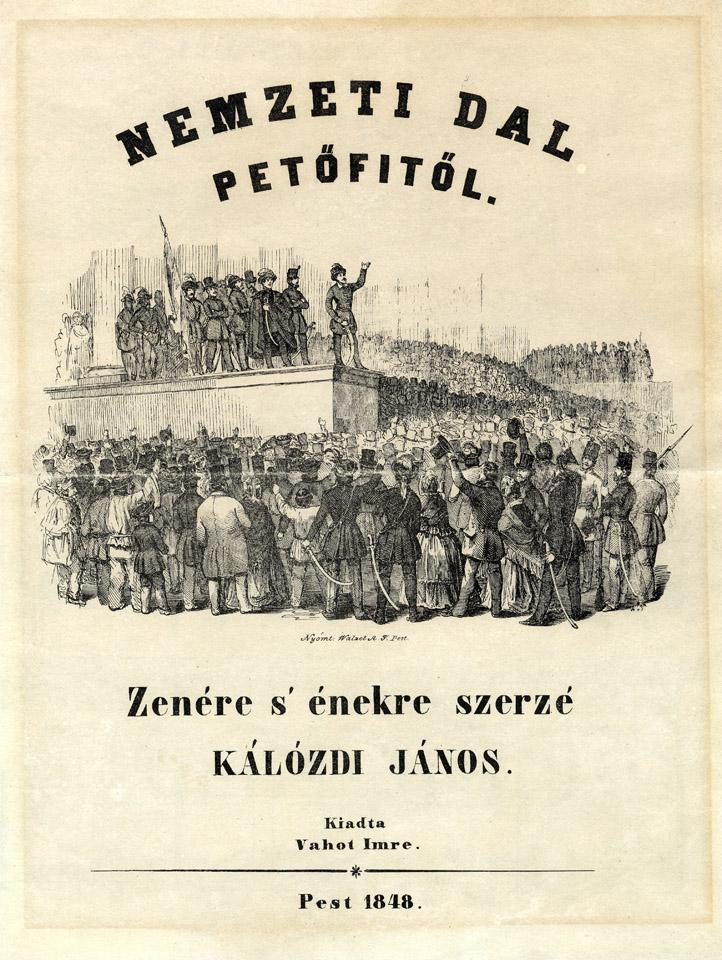
The Hungarian National Museum played a significant role in the events of the Revolution and War of Independence of 1848–1849. On 15 March 1848, the square in front of the museum façade became one of the revolution’s most memorable sites, where—contrary to later tradition—Sándor Petőfi did not recite the National Song, though he did address the crowd. During 1848–1849, the square in front of the Museum served as the venue for numerous public assemblies. The Museum’s Ceremonial Hall hosted sessions of the Upper House of the first representative National Assembly of 1848. (In later years, the House of Representatives met here in 1861 and 1865–1866, while from 1867 until 1902, before the construction of today’s Parliament building, the Upper House also operated in the Museum.) From this period onward, the building of the National Museum became not only the guardian and presenter of the nation’s most important collections, but also a symbol of national freedom. This symbolic role is expressed to this day by the fact that the central state commemoration of Hungary’s national holiday is held each year in front of the Museum.
History of the Museum to date
In the second half of the 19th century, outstanding scholars such as Ágoston Kubinyi, Flóris Rómer, József Hampel, Ottó Herman, and Ferenc Pulszky carried out their work within these walls. By this time, the dynamically expanding collections had already outgrown the physical limits of the institution. At the same time, developments in international museology increasingly favoured specialisation and the establishment of specialised museums. As a result, parts of the national museum collections were separated to form independent institutions: the Museum of Applied Arts became autonomous in 1872, and in 1896, part of the picture collection gave rise to the Museum of Fine Arts. A comprehensive renovation of the building took place in 1926–1927. Based on the designs of Jenő Kismarty-Lechner, new spaces were created within the attic, temporarily resolving the museum’s storage problems. The next major reconstruction occurred between 1996 and 2006, when—among other developments—workspaces and new exhibition areas were created beneath the two inner courtyards, including the Roman Lapidarium.
Affiliated institutions
The Museum Act of 1949 declared the separation of the Museum of Ethnography and the Hungarian Natural History Museum, as well as the independence of the National Széchényi Library. In the 1960s, several outstanding historical building complexes were placed under the professional supervision of the Hungarian National Museum as regional branch institutions, thereby emphasising their national significance. These included the King Matthias Museum in Visegrád, the Rákóczi Museum in Sárospatak, and the Kossuth Museum in Monok (until 2008). From 1985, this circle was expanded by the Castle Museum of Esztergom.
In 2012, the Hungarian National Museum was further expanded with additional affiliates, when several museums previously operating within the county museum system were integrated into its organisational structure. These included the István Széchenyi Memorial Exhibition, the Ádám Vay Museum Collection, the István Báthory Museum, the Palóc Museum, the Villa Romana Baláca (a Roman villa estate and archaeological park), the Vésztő-Mágor Historical Memorial Site, the Csolt Monastery Medieval Ruin Garden, and the Bálint Balassa Museum in Esztergom. Among these, the István Széchenyi Memorial Exhibition in Nagycenk—classified as a public-interest exhibition venue—was reclassified as a thematic museum at the initiative of the Hungarian National Museum. In the autumn of 2014, it was transferred by the government to the Esterházy Cultural, Research and Festival Centre under the name István Széchenyi Memorial Museum. During the slightly more than one and a half years in which the exhibition venue operated within the organisation of the National Museum, a new permanent exhibition was successfully created in Nagycenk. Subsequently, the Ferenc Kubinyi Museum in Szécsény also joined the network of affiliated museums; in 2022, it was renamed the Forgách–Lipthay Castle Museum.
As of 1 January 2022, in accordance with legislative changes, the coordination, execution, and commissioning of archaeological tasks related to major national investment projects throughout Hungary were assigned to the Hungarian National Museum (operating from 28 April 2024 under the name Hungarian National Museum Public Collections Centre – Hungarian National Museum). To fulfil these responsibilities, the Museum established the National Archaeological Institute (MNM NAI), which was created through the merger of all predecessor units, including the Archaeological Heritage Protection Directorate, the Applied Natural Sciences Laboratory, the Archaeological Department of the Hungarian National Museum, and the archaeological units of Várkapitányság Nonprofit Zrt.