The foundations of the Collection of Musical Intruments were laid in the mid-19th century with three outstanding pieces: a virginal, purchased by the museum in 1836 from the Jankovich Collection as the instrument of Princess Catherine of Brandenburg; a harpsichord from the Thököly family, a donation in 1847, and a harp attributed to Queen Marie Antoinette of France, a donation, too, in 1852. After that, musical instruments were mainly collected through donations. In 1902, the Delhaes estate was added to the collection, which meant a significant increase in size, as 50 valuable instruments entered the museum at once. Although instruments of European interest were also included among the objects (Beethoven's and Liszt's Broadwood pianos, Haydn and Miklós Esterházy's Stadlmann baryton, Vencel József Schunda's first pedal hammered dulcimer, "tárogató"-s (Hungarian reed instrument), etc.), the instruments in the museum have only formed a separate collection since 1957.
Contact: Dr. Klára Radnóti, radnoti.klara@hnm.hu, phone: +36 1 327 7716
The composition of the instrument collection
The acquisition scope includes instruments representing Hungarian instrument manufacturing and use, as well as musical instruments associated with historical figures and families. The collection contains a wide variety of items, organized and grouped according to scientific classification. Accordingly, the Hungarian National Museum preserves idiophones (e.g., xylophone, glass harmonica), membranophones (drums, mirliton), aerophones (wind instruments, organ, harmonium), chordophones (string instruments), and mechanical instruments (music box, barrel organ). In addition, the collection also houses other music-related artifacts, such as music stands, tuning keys, instrument-making tools, etc.
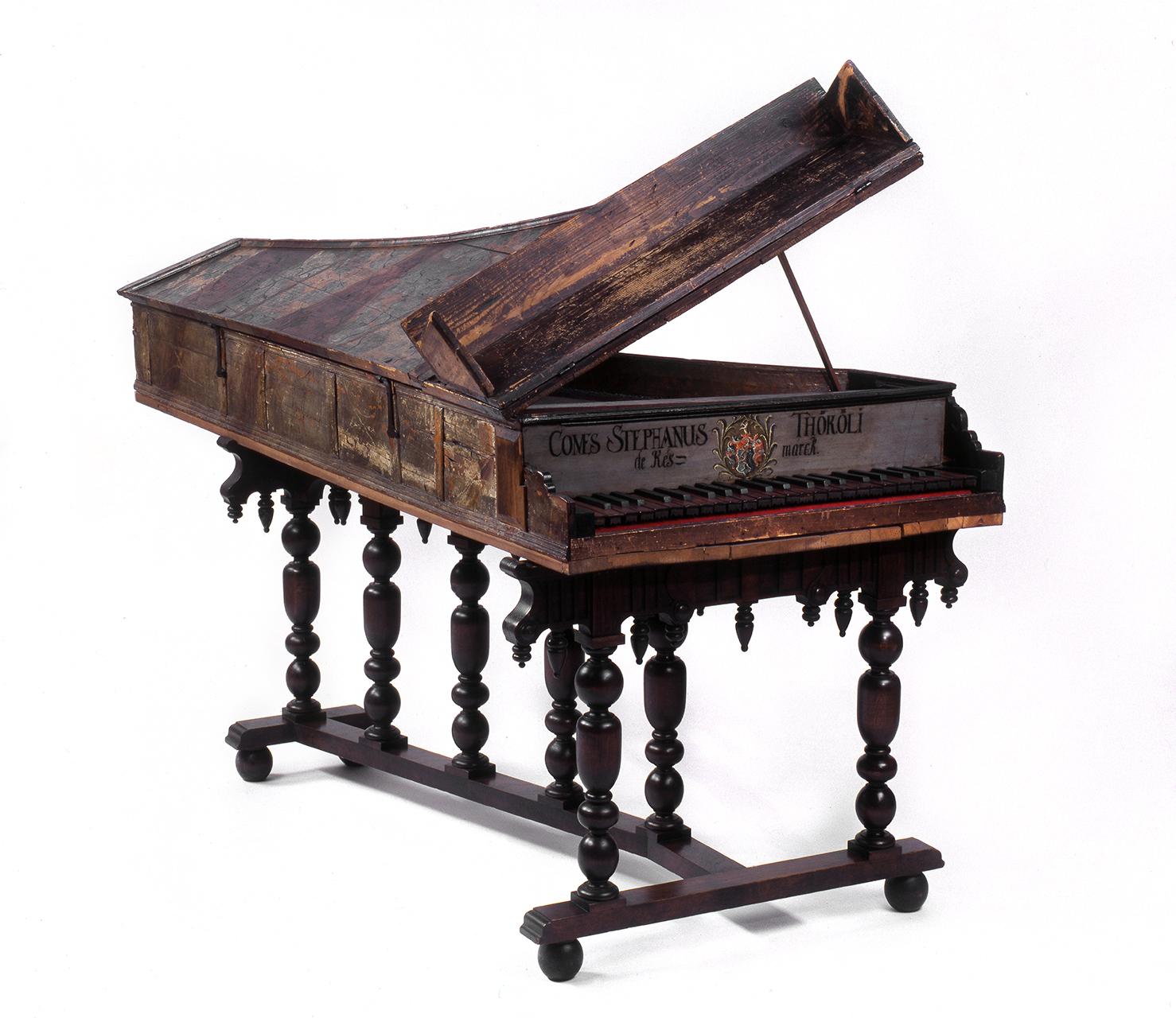
The instrument of István Thököly (1581–1652) (father of Imre Thököly) was probably made by a Venetian master, Vitus Trasuntinus. Around 1600, Thököly visited Italy and studied at the University of Padova – as was customary at the time, studying in Italy and learning music were part of the education of young people from prominent families – and it was probably then that he purchased the instrument. Unfortunately, the original case and the maker's mark have not survived. The current paintwork and modifications were carried out at the family estate in Árva. The front plate bears the Thököly family coat of arms and the inscription COMES STEPHANUS THÖKÖLI de Kesmarck. The instrument was donated to the National Museum's collection in 1847.
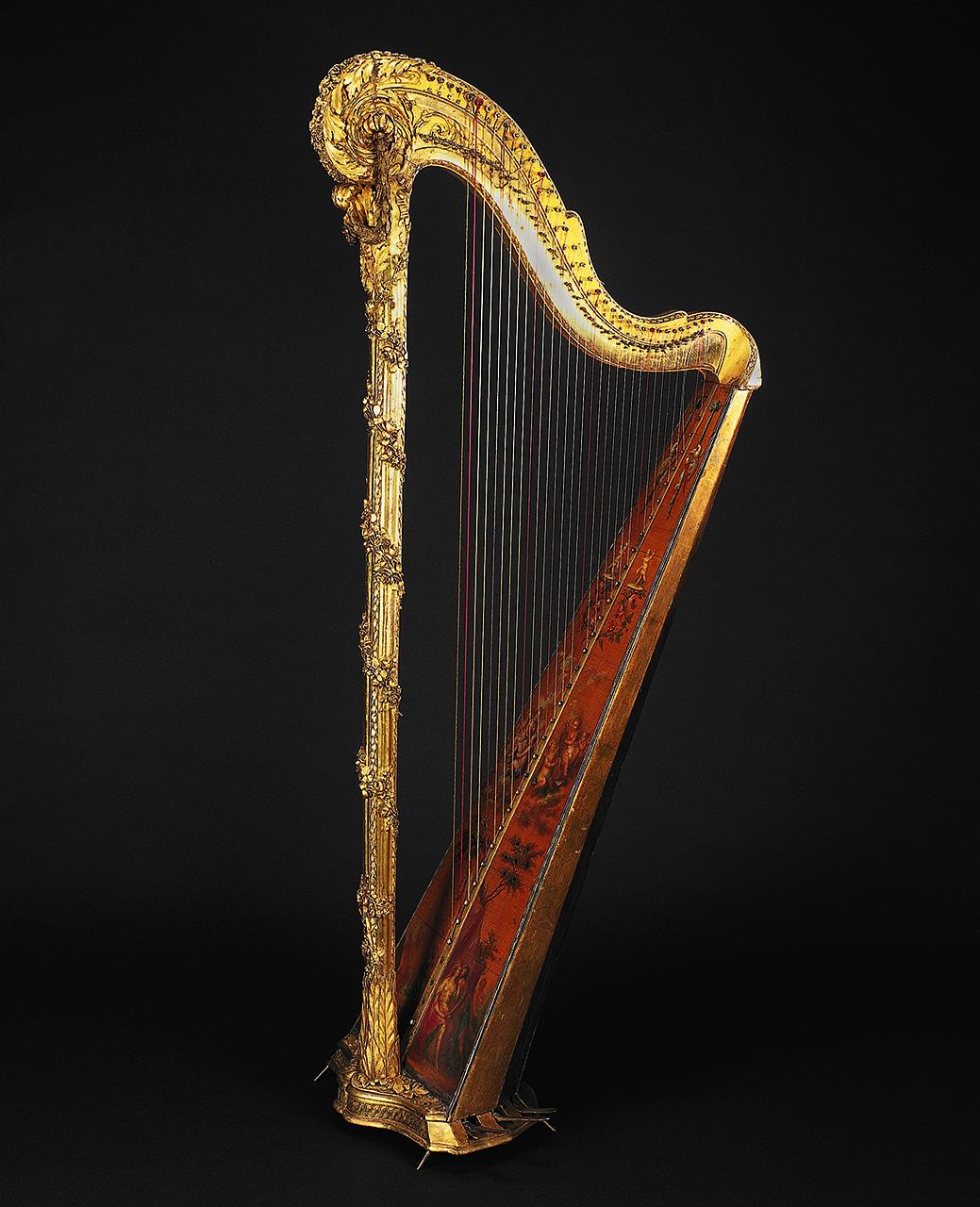
Based on tradition and probable data, the so-called "golden harp" was once owned by Louis XVI's wife, Queen Marie-Antoinette of France. It is a richly gilded, carved instrument, the body of which is decorated with paintings: Venus is frolicking with Mars, while the child Cupid is trying on the helmet of the god of war. Master Cousineau was one of the most important instrument makers of his time, supplier to the French royal court, and one of the perfectors of the simple pedal mechanism. The harp has 35 strings and may be tuned during play without the use of hands, thanks to its seven pedals.
It entered the museum as a donation. The original donation documents were destroyed during World War II, but according to contemporary memoirs, Count Móric Benyovszky (King of Madagascar, who lived for a long time at the French court) received it as a gift from the queen, and it later came into the museum's possession through his family after an adventurous journey. (Master's mark: COUSINEAU RUE DES POULIS, between 1770 and 1780)
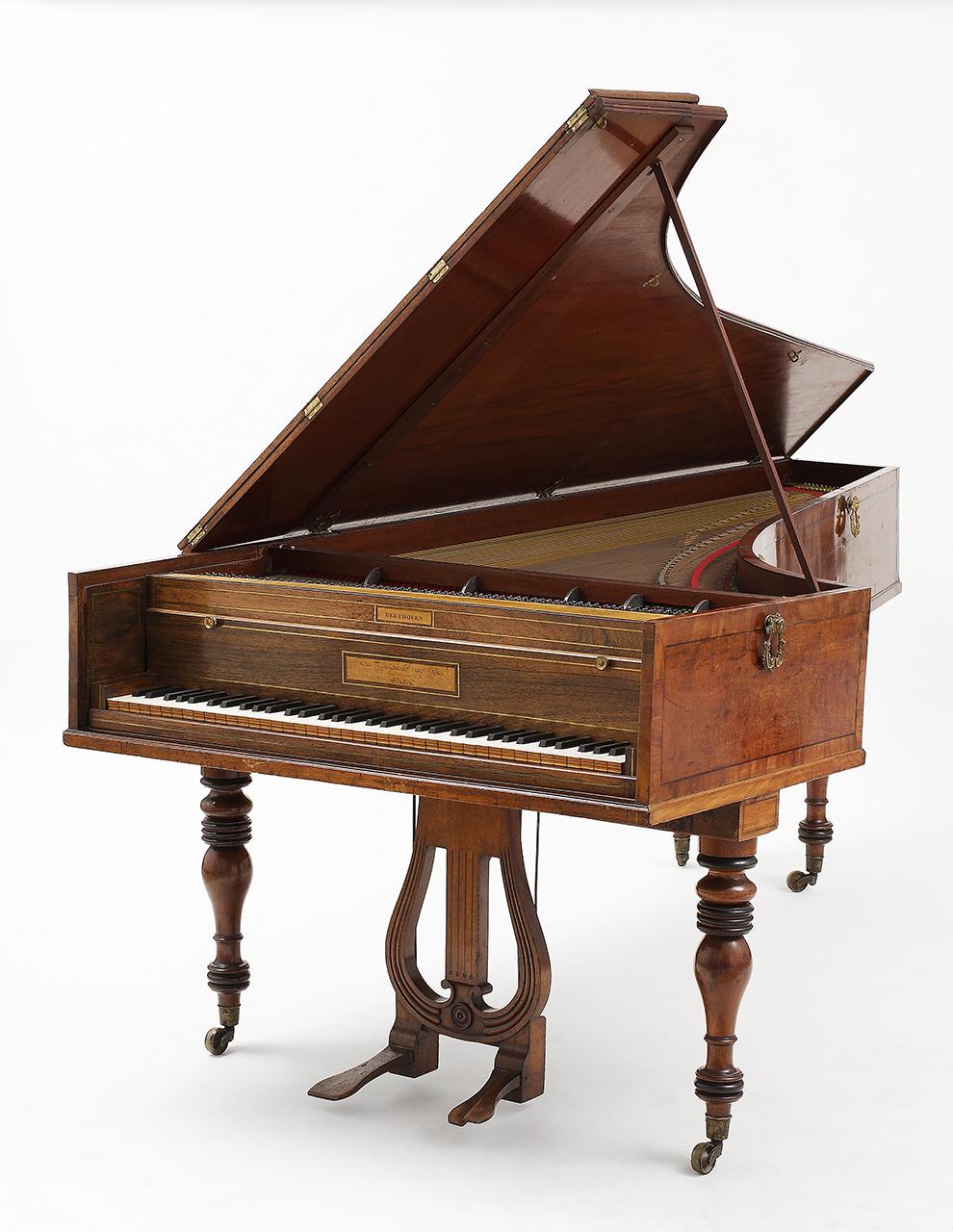
In May 1887, at the bequest of Franz Liszt, his most treasured possessions arrived at the National Museum. The most notable item in the estate is the piano that Thomas Broadwood sent to Beethoven in Vienna in 1817. The London-based Broadwood company presented the master with its most modern and finest piano of the time, inscribing his name and the fact of the gift on the front of the instrument. Beethoven loved this piano and used it till the end of his life. Afterwards, his possessions were auctioned off, and the instrument was purchased by C. A. Spina, a Viennese art dealer, who gave it to Liszt in 1845 as a token of his admiration. During the celebrations of his 50th artistic anniversary in Pest in 1873, the artist decided to donate his most valuable memorabilia to the National Museum as a Hungarian patriot, "whose pride it is to offer his modest artistic talent to the service of Hungary," he wrote to director Ferenc Pulszky. The instrument finally entered the museum after Liszt's death, where it was exhibited together with other relics in September 1887, and has remained one of the museum's most treasured possessions ever since. (Thomas Broadwood, London, 1817)
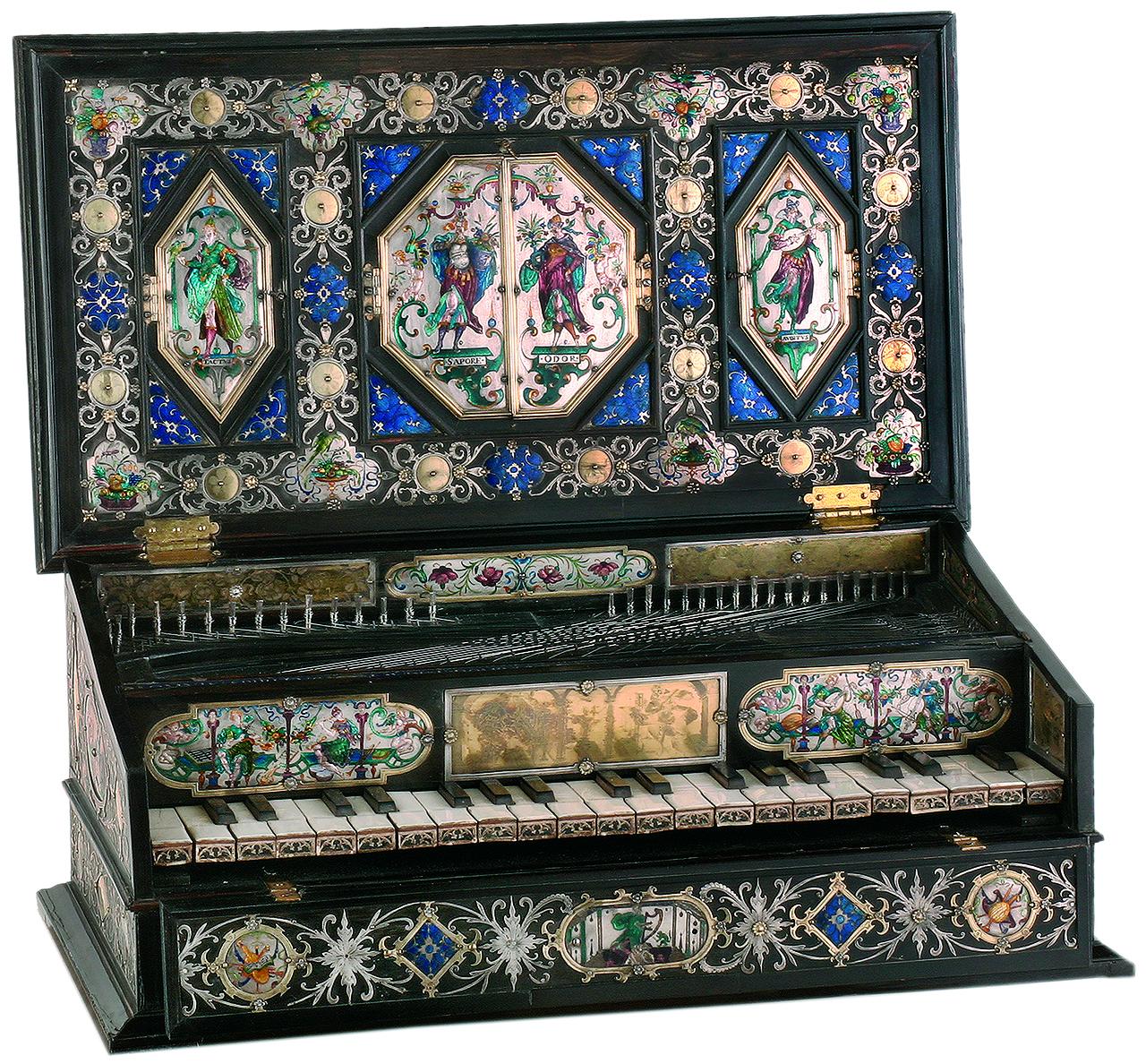
A small chest decorated with metalwork, with a sloping lid covered with red (originally green) velvet cushion, with drawers underneath. The chest features allegorical representations of the seven liberal arts and the four seasons. Inside the lid, from left to right, are enamel allegories of Tactus (Touch), Sapore (Taste) and Odor (Smell), followed by Auditus (Hearing). Behind the depictions of the senses are painted biblical scenes, and below Auditus is the signature (LKI IKF) and the date (1617). Above the keys are the inscriptions "OMNIS SPIRITUS LAUDET DOMINUM" (all souls praise the Lord) and "SIC TRANSIT GLORIA MUNDI" (thus passes the glory of the world). The museum purchased it from the collection of Miklós Jankovich as an instrument belonging to Catherine of Brandenburg (second wife of Gábor Bethlen, Prince of Transylvania). The craftsmanship of the instrument and written sources indicate that it was indeed owned by the prince. (From the south of Germany, maybe Augsburg, 1617, black-painted wooden body, red velvet cushion on top, decorated with enamel and gilded silver plates)
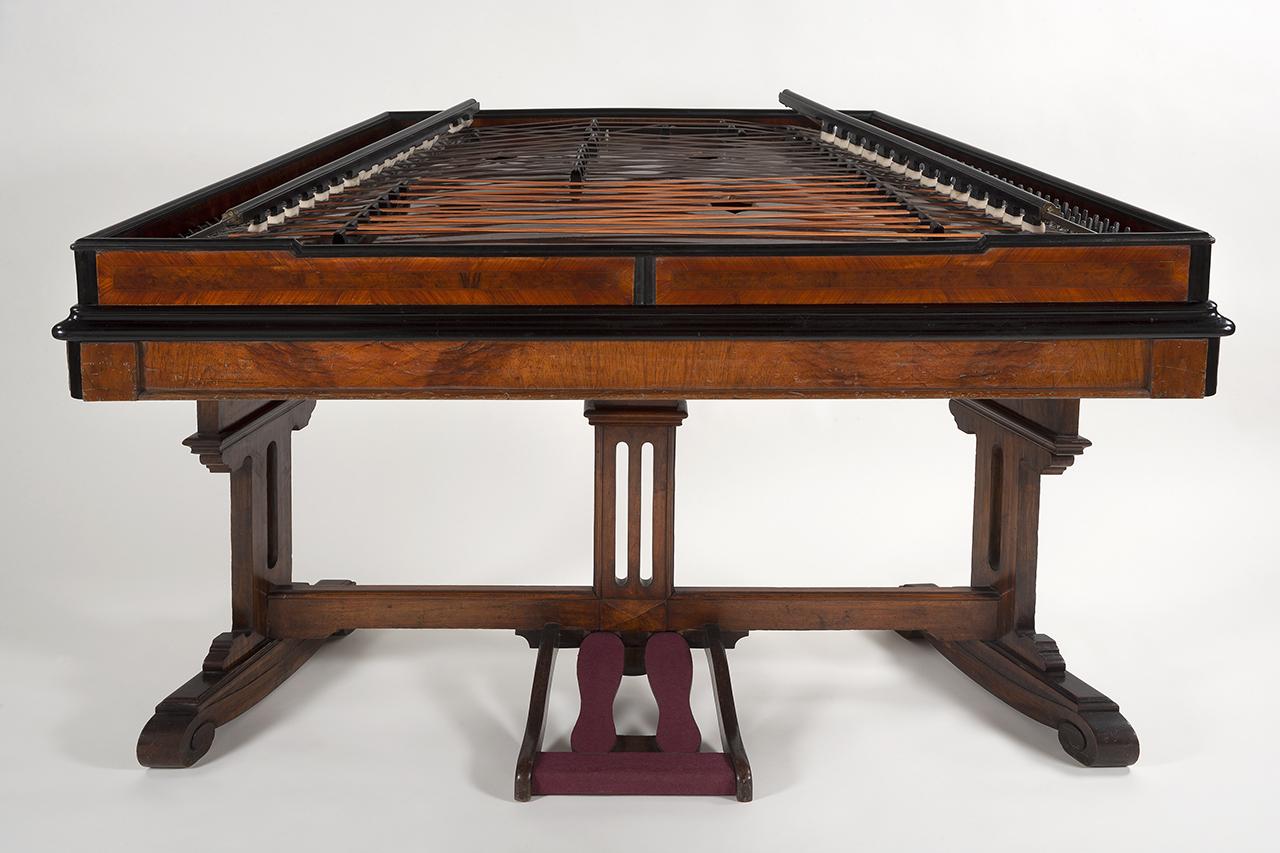
A simple, brown instrument, Schunda Vencel József's first hammered dulcimer with pedals.
The Schunda company, which played a prominent role in the history of Hungarian instrument making, dates back to the 1840s, when Josef Schunda, born in Czechia, became an assistant to master instrument maker Keresztély Juul in Pest. After Juul's death, Schunda married his widow and continued the business. His younger brothers learned the trade from him, and the most talented of them, József Vencel (1845–1923), proved to be a gifted businessman and instrument maker, and brought the business to prosperity. He became an imperial and royal supplier, and his name is associated with inventions such as the hammered dulcimer with pedals (1874) and the modern "tárogató" (reed woodwind). He regularly participated in world exhibitions with his products, his instruments became increasingly sought after, and by 1900 his factory had sold its 10,000th hammered dulcimer. As a Hungarian patriot, he felt it was his duty to donate his first patented item to the National Museum. (Master's mark: József Schunda V., Pest, 1874)